Author: Admin

  • KU Political Science Professor Patrick Miller Discusses The Upcoming Elections

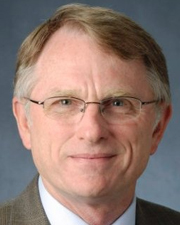
    Patrick Miller KU | Lawrence Central RotaryPatrick R. Miller, Assistant Professor of Political Science at the University of Kansas, emphasized the long-term consequences of the political races underway in both Kansas and the nation.

    Miller pointed out that this election cycle in Kansas is really Governor Brownback’s “midterm”. Brownback is currently considered the most unpopular governor in the country, so it is likely that Democrats and moderate Republicans will gain seats in the legislature this fall in reaction to his policies. Despite these gains, Republicans will continue to control both the House and the Senate.  Republican legislative leaders will struggle to bring together both the conservative and moderate wings of their party to get consensus to pass legislation.  As a result, Miller does not expect that the volatile issues of the day, such as tax cuts or block grant structures, will be changed during the upcoming legislative session.

    Nationally, Miller pointed out that Clinton is likely to win the presidency and projects that Democrats may regain control of the Senate.  Although Republicans have good control of the maps that will allow them to control the House, they are divided among themselves.  The conservatives will hold onto their seats there, while more moderate Representatives are more likely to lose to Democrats.  As a result, divided government is likely for the foreseeable future.

    The Republican Party is now more and more identified as the party of white Americans, according to recent surveys.  Trump’s candidacy has attracted those voters with less education and lower incomes, despite the fact that that constituency has traditionally voted Democratic.  College-educated, higher income voters, more likely to vote, are now leaning toward the Democratic ticket.  While Trump has not caused these changes, he is the symptom of them, according to Miller.

    In Kansas, Miller noted that Kevin Yoder and Lynn Jenkins, Republicans on the ballot for national office, are not only distancing themselves from Clinton, but also from Trump and Brownback, despite the fact that their voting records are very conservative.

    Dr. Miller, a specialist in American politics, conducts research on political psychology, public opinion, electoral behavior, political communication, and survey and experimental methods.  He did his undergraduate studies at the College of William & Mary and received his doctorate from the University of North Carolina at Chapel Hill.  He is also certified in survey research methodology from UNC Howard W. Odum Institute for Research in Social Science.
  • Lawrence Utilities Engineer Melinda Harger Updates Lawrence Central On New Wakarusa Wastewater Treatment Project

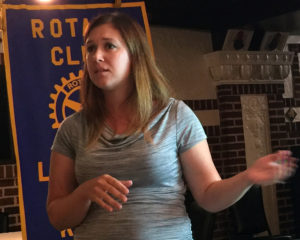
    melinda-hargerMelinda Harger, Utilities Engineer for the City of Lawrence, reported on the progress of the 74.1 million dollar construction of the new Wakarusa Wastewater Treatment Project.  The project, the largest ever undertaken by the City, was identified in the 2003 Utilities Master Plan to address the needs of a growing community.  The plan was intended to mitigate wet weather surcharging of the 31st Street corridor, reduce wet weather overloading of the existing treatment plant, provide 20 percent growth capacity, and to address new environmental regulations. Elements of the plan include a new wastewater treatment plant, a new pump station, and improvements to the existing plant.  An authorizing resolution passed in 2007, but the project was put on hold a few months later due to the nationwide economic downturn.  The project was taken up again in 2012 and the RFP process and bidding soon followed.  The extensive project required a team of contractors who are working closely with the Utilities Department of the City.  The project site at 31st and Louisiana required considerable site preparation, including earthwork and access roads.  The permit process was complicated, as some 60 were required, as much of the area is a wetland.  The city worked closely with the Baker Wetlands, adding enhancements such as trail and parking lot construction as part of an easement agreement.  The plant is expected to be up and running by March of 2018.  The new Lawrence plant is projected to serve as a model for other communities for handling wastewater and meeting new regulations.  For more information on the project contact Melinda Harger at City Hall.

  • Lawrence’s 2016 Fall Community Bike Ride Scheduled for Sept 17th

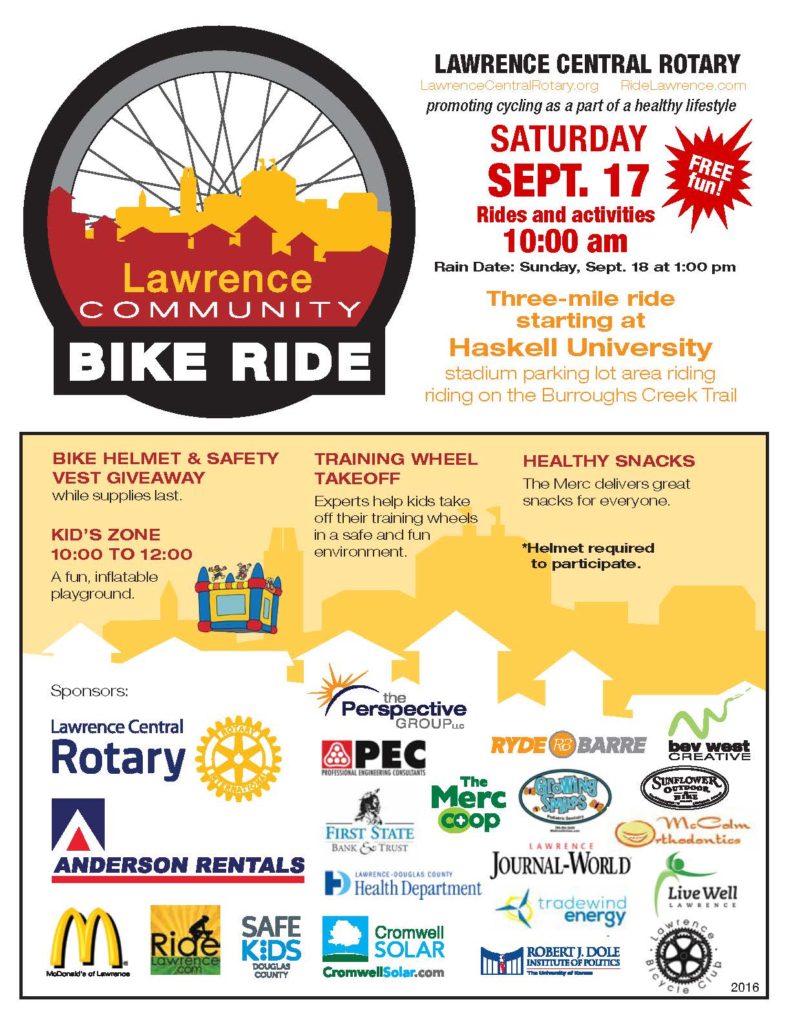
    The 2016 Lawrence Community Bike Ride on Saturday, September 17th, at the Haskell University stadium parking area and using the Burroughs Creek, and recently refinished bike Trail south of Haskell.

    The event is open to anyone and there is no cost to participate.

    There will be a three-mile ride along the Burroughs Creek Trail.

    Other activities from 10 a.m. to 12 p.m. include:

    • A Training Wheel Takeoff. Experts will help children who are ready to take off their training wheels in a safe environment.
    • Bike Rodeo. Kids can practice and improve their riding skills
    • Bike Helmet Fitting and Giveaway. Safe Kids with LMH will help outfit kids with helmets, while supplies last, along with providing cycling safety tips for kids of all ages – and for adults too!
    • Inflatable Bounce House and Slides for the kids!

    “One of our goals as a club is to get more and more people discover cycling and an active lifestyle as a fun and healthy activity,” said Steve Lane, a member of Central Rotary Club. “This event is a great opportunity for families and individuals to enjoy cycling in a safe and scenic area on Lawrence’s east side.”

    If it is raining September 17th, the ride will be rescheduled for on Sunday, September 18th, at 1PM.

    Registration for the event is required and can be done before the event.

    Releases will be available at the event or you can download one HERE to fill out ahead of time.

    Thanks to all our sponsors and partners who help to make these events happen in Lawrence.

    Lawrence Fall Community Bike Ride 2016

  • Kansas River Keeper Dawn Buehler on Protecting and Preserving the Kansas (Kaw) River

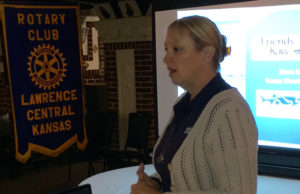
    ks-river-keepersThe Kansas River Keeper sounds like a mythical being but is actually a native Kansan who says she is the eyes, the ears and the voice of the river.

    Dawn Buehler is the Kansas River Keeper and says her mission is to protect and preserve the Kansas (Kaw) River for future generations.

    Buehler heads an organization of more than 100 volunteers who work to maintain the river quality on the longest prairie-based river system in the world. The Kansas River watershed covers 53,000 square miles and  is part of the Missouri River watershed that includes parts of Colorado and Nebraska as well as Kansas.

    From her office in DeSoto, she responds to pollution reports from the Kansas Department of Health and Environment and uses the USGS site to check for safe water levels. Challenges to the river include storm water, land use changes, agriculture, population increases which increase demands on the river, and the need to protect the drinking water supply.The River Keeper volunteers work with groups and companies such as Westar Energy, Bowersock, and the Kansas Basin Regional Advisory Committee as well as listening to public input. They are supported entirely by grants, fund raising events and donations.

    The River Keeper volunteers work with groups and companies such as Westar Energy, Bowersock, and the Kansas Basin Regional Advisory Committee as well as listening to public input. They are supported entirely by grants, fundraising events, and donations.

    The Kansas  River is one of three public waterways in the state and the volunteers encourage paddle trips and educational activities on the river.friends-of-the-kaw

    River Keeper events this fall include a September Lawrence to Eudora paddle and an October cleanup where the Kaw meets the Missouri.

    For more information visit the Friends of the Kaw Website.

  • KU’s James Modig Discusses the New Central District Project to Lawrence Central

    james-modigProgress on the Central District Development Project is increasingly visible at Kansas University. The $350 million project is transforming a 45-acre space that lies north and east of the Iowa and 19th Street into “Innovation Way.”  Financing was completed and construction began in January 2016.

    Jim Modig, University Architect and Director of Design and Construction Management (DCM) at KU, took care to describe the scope and history of the project in his presentation to the club.  The project is the tangible result of KU’s Master Plan for 2014-2024.  In particular, that plan recognized that existing spaces for science classes at KU were suffering from delayed maintenance and were too small, unsafe, and outdated to attract the best students.

    The scope of the Central District Development work includes creating Jayhawk Trail that will tie the campus together end-to-end with accessible access for pedestrians and bicyclists.  A new Integrated Sciences building is designed to encourage innovation and collaboration among students of various scientific disciplines.  A new student union with flexible conference space, a parking garage for 600 cars, a new central utility plant, new apartments, and a new residence hall with dining facility are also part of the plan.  The images of the residence hall in time lapse photographs reveal the speed of the work.

    Companies from all over the world expressed interest in bidding on this project, Modig said, but after reviewing the qualifications of those companies, the project team asked for a Request for Proposal (RFP) from three firms.  The RFPs addressed building of the science facilities, modernizing the campus infrastructure, providing student housing, and addressing ongoing operations and maintenance.

    The Central District Development Project has been financed through a public/private partnership (P3), a non-profit entity that ensures that the State and the Board of Regents are not liable for the debt.

    The economic impact of the Central District Development Project is significant, according to Modig.  The project employs more than 8,500 people directly and indirectly.  For every $1 spent, the project generates $2.47 in incremental economic value.  Seventy-five percent of the subcontractors for the projects underway have been awarded to Kansas-based businesses;  another 20% have gone to companies in the Kansas City area; only 5% have been given out-of-state.