Author: Admin

  • Tour of Lawrence’s Bob Sanner Discusses the 2015 Race

    ToL2015_Logo100x202The Tour of Lawrence was a three day  cycling celebration that began downtown on June  26 with street sprints and an evening of music and family entertainment.

    Saturday the Campus Criterium Race showcased Haskell Indian Nations  University and the Breezedale Historic District with a 2.2 mile loop bicycle course, followed by at Downtown Criterium that used the former two-time Collegiate National Championship course. Case prizes for the weekend totaled over $20,000.
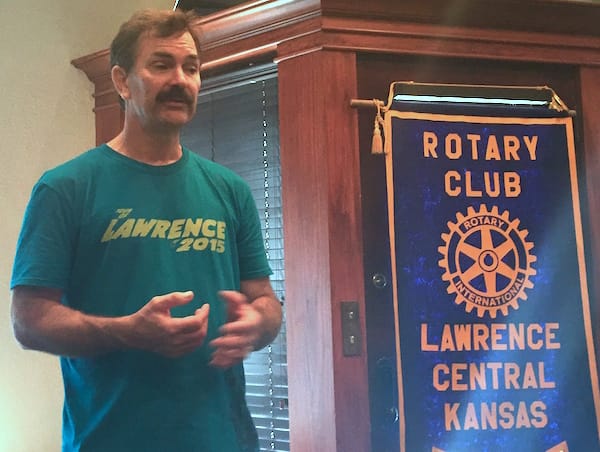
    Bob SannerBob Sanner of the Lawrence Convention and Visitors’ Bureau said events like this help bring the community together and also get national attention for Lawrence.

    “Seven hundred riders in the race and 2500 people downtown help create the idea that Lawrence is THE Midwest events destination,”  Sanner said. “It helps sell Lawrence to corporations and shows companies that they should bring their events, conferences and meetings to Lawrence.

    “Our downtown track meet even got international attention. All these events demonstrate what Lawrence can do.”

    Sanner said he is thankful for volunteers, some of whom came from Central Rotary, who man these events.  He believe in promoting  events on social media using the slogans “Explore Lawrence,” and “Unmistakably Lawrence.”

    “Being a university community helps,” he said. “There’s a youthful vibe  that I really  enjoy.”

  • Susan Earle Discusses the Aaron Douglas Mural Project

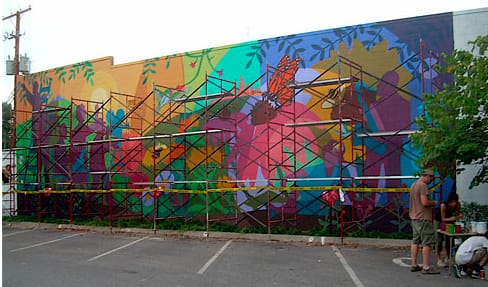
    Susan Earle - Curator, European & American Art - KU Spencer GallerySusan Earle, curator of European and American art at the Spencer museum chronicled the life and death of a downtown Lawrence mural when she told the story of The Pollinator.

    The Pollinator was on a wall of what was then the Aquila building at 9th and New Hampshire from 2007 until March, 2015. It was inspired by the work of Aaron Douglas, a black Topeka artist, who graduated from Topeka High School in 1917 and, against formidable odds, became the first black to get an art degree at Nebraska University. He also earned a masters degree at Columbia. He studied in Paris, taught at Fisk University and, in addition to murals, designed posters, book covers for major authors and journal covers.

    Aaron Douglas Mural ProjectAfter the Spencer purchased one of his murals, the idea grew for a mural in Lawrence to commemorate the influence of Douglas and other Kansas blacks including Langston Hughes, Gordon Parks and Gwendolyn Brooks, in pollinating art in America. The mural’s name reflects one of Brooks’ poems: “We are each others’ harvest . . .”

    Local artist David Lowenstein led the project, aided by a large committee which included Central Rotarian Carolyn Chinn Lewis. Grants, community support and private donations provided funding. The completed mural faced the Farmers’ Market, creating a downtown site celebrating all aspects of the harvest.

    By 2014 the building had been sold and marked for demolition. “We spent months trying to figure out a way to save the mural,” Earle said. “ We thought of moving the wall or taking it apart brick by brick.” But none of these ideas worked and the building was demolished in March.

    “The owners have promised us wall space for a mural on the new multi-purpose building they are constructing at the site,” Earle said. “And it will still face the Farmers’ Market.

  • Doctor Roger L. Boyd Talks About the Baker Wetlands

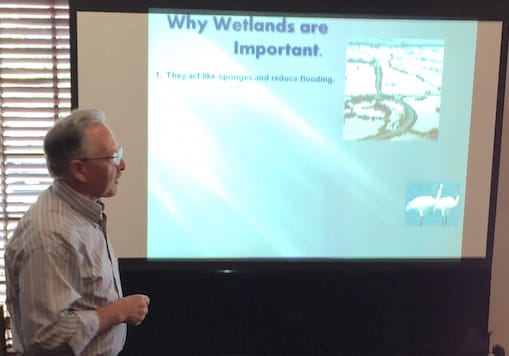
    Roger Boyd Discusses the Baker WetlandsThe Baker Wetlands was the subject of Doctor Roger L. Boyd’s presentation. Doctor Boyd is the Baker Wetlands Education Coordinator and a biology professor emeritus, Baker University. Preservation of wetlands is important where ever they are found as they function as a check on flooding, filter pollutants and serve as a unique habitat for plants and animals. Haskell University acquired the area in 1854 and drained it and used it for agricultural instruction. Baker University acquired the site in 1968 and in 1990 restoration began. Drainage ditches were plugged with good results. A thirty year controversy threatened the project as plans to link up highway 10 with a passage through the wetlands was fought over. The project was finally approved with a promise to reduce the impact of a roadway on the area and there was a significant property exchange that benefited both parties.

    An 11,800 square foot Discovery Center will open in July and there are plans for camping areas and trails. Recent rains have speeded up the restoration. The Baker Wetlands will function as a giant outdoor classroom for area students and researchers from Haskell University, Emporia State University and Kansas University.

  • Prof. Mark Gerges Discusses the Fall of France in World War II

    Prof Mark Gerges discusses the 75th anniversary of the fall of France to Nazi GermanyMark Gerges, Assistant Professor from the Department of Military History at Ft. Leavenworth, marked the 75th anniversary of the fall of France to Nazi Germany with his program at Lawrence Central Rotary.  This historic event occurred in June 1940.  Gerges’ explained that the fall was not a result of superior German military skill or resources, as some have claimed.  Rather, France fell as the result of a number of small twists of luck and the initiative of a few German leaders.

    Gerges used maps to highlight the planned movement of allied forces and German onslaughts.  The French front was brittle; it had had no depth of resources.  Half as many men were in the French army in 1940 compared to its force in 1914.  But Germany was not as strong as they claimed either.  In particular, the German tanks were not as plentiful along the French front as portrayed in the media.  The photos of hefty German tanks were of tanks actually located in Norway, not on the French border.

    Gerges also emphasized the strength and weakness of the two different command and control models that the  Germans and the Allies used.  The Germans encouraged individual initiative and maneuvering;  the French used a “fan” approach where central control managed troop movements.  Gerges believe that the German model is what gave them the victory.

    Gerges will speak on “The Fall of France” at KC Library on Tuesday, June 30, at 6:30 p.m.

  • KU Business School’s Dee Steinle Discusses the New Online MBA Program

    KU School of Business' Dee SteinleThe School of Business at KU is launching anew online MBA program. The new facet to the school was presented by Administrative Director of Masters Programs, Dee Steinle, who is the wife of Central Rotarian Michael Steinle.

    “It’s an interesting way for a University to do business,” she said of the growing online presence  of university classes.

    “Two years ago KU launched an online special education degree,” Steinle said. When market research showed an MBA would find an audience,  the process began.

    Citing her own middle school aged son’s ease with learning online she said predictions are that by 2020 there will be five million online students in the country.  Currently there are 450 MBA programs on line but only 20 are ranked programs. “It’s getting harder for people to attend classes in person,” she said “so this is the answer.”

    KU will provide the “talent,” creating the syllabus and teaching the courses, the first one to be offered in August, the second in October. EverSpring, a private company out of  Chicago will handle the technical details.

    “There’s going to be a lot of learning on my part as we ramp this up,” she said.  They are formulating an admissions process and creating an eight-week cycle of class offerings. “We will  try to keep human touches too, providing places for students and graduates of the program to come together.

    For more information about the program point your browser to http://onlinemba.ku.edu/online-mba/