Author: Admin

  • Dr. David Farber Speaks on the Rise of President Donald Trump

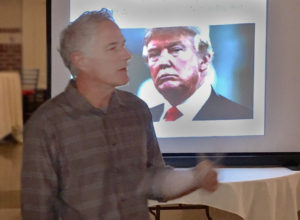
    Distinguished Professor Dr. David Farber, History Department, University of Kansas
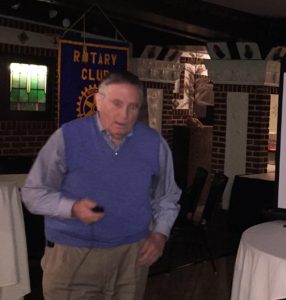
    Dr. David Farber Talks to Lawrence Central Rotary on the rise of Trumpism

    Donald Trump is like no other American President according to Distinguished Professor Dr. David Farber, History Department, University of Kansas.  Dr. Farber earned his advanced degrees from the University of Chicago and has written extensively on politics, social change and business in modern America.  He began with identifying the formula that propelled Donald Trump to a victory in the Republican Primary and electoral success in the Presidential election.  He noted that a primary has a smaller pool of voters, therefore, huge numbers are not necessary for success.  Donald Trump built his own unique brand that appealed to white ethnic nationalism.  He used Birtherism, the belief that President Barack Obama was not born in America and might not be a Christian, to appeal to people inclined to be angry ethnic nationalists.

    Dr. Farber noted that polls indicated that 72% of Republican Primary voters believed the Birther arguments.  Donald Trump gambled that free trade and immigration would work with primary voters.  He used demagogue like techniques and arguments and won a surprising victory over the established leaders of the party.  He won approximately 50% of primary voters and once the choice came down to two Presidential candidates, the establishment Republicans “came home” and voted for Donald Trump. He also earned enough support from independent voters, primarily white males in key states, to win the Presidency.  Dr. Farber noted that the Clinton Campaign underestimated support from union members, Blacks and Hispanics and that contributed to her loss.  Regarding Donald Trump’s performance so far, Dr. Farber maintains that we have never had a President who knows so little about power and governing.
  • Van Go: An Artistic Path to Success

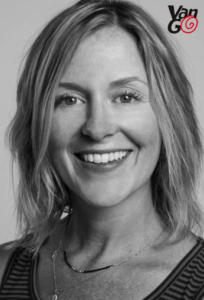
    Van-Go Development Director Eliza Darmon

    Van Go is a unique and creative non-profit program that has provided employment, guidance, and success for disadvantaged youth in the Lawrence community.  Development Director Eliza Darmon presented the story of this award -winning program started 20 years ago by Lynn Green with a modest Arts Commission grant.

    Van Go has grown into an arts based social service and jobs program serving at-risk teens aged 14-24.  Van Go operates a year-round after school and summer job training experience utilizing local businesses, nonprofits, and community members who provide over 100 youth employment opportunities annually.  Young people are usually referred to Van Go through school social workers and have an IEP, a mental health diagnosis or have been in the court system.  Some 70 percent of these young people live in poverty.  Accordingly, the program is committed to providing a support system which includes academics and tutoring, counseling, encouraging a healthy lifestyle and other life skills.  Clients participate in Bench Mark, an eight weeks employment program in which a bench is constructed and placed in the community.  The Adornment program employs 22 clients to produce art and decorations for the yearly Van Go recognition ceremony.  Young people also plan and paint a mural each spring.  A tile recognition wall also provides employment with colorful fused tiles representing over 700 donors.

    Van Go has a budget of $743,000 with almost half coming from Federal, City and County funding.  The rest comes from donations, fundraisers, art sales, two well-attended annual dinners, and an on-site gallery that is open 9:00 am through 5:00 pm.  The Van Go website is http://www.van-go.org/.

  • Feeding the Hungry in Douglas County – Just Food’s Mission

    Brandon DeinesBrandon Deines, President of the Board of Directors of Just Food, presented a program on the activities of the Douglas County Food Bank.

    Brandon grew up in Hoxie, Kansas where he spent many hours working in the family grocery store.  That early experience and a desire to serve the community made his commitment to Just Food a good match.

    Just Food supplies more than 40 partner agencies with fresh produce, frozen meat, bread and other food.  Client services also include instruction on growing vegetables and healthy cooking classes.  The organization believes that access to nutritious food is a fundamental human right and they also teach self- sufficiency.

    Just Food collaborates with numerous community partners and over 400 annual food drives.  Gifts of cash are particularly welcome as currency provides the most efficient way feed people.  An annual dance and a fundraising dinner both receive considerable community support.  The Just Food Pantry is open five days a week and clients may fill a bag or box with food once a month.  However, fresh vegetables and bread are available daily.  A mobile food pantry and several other pantry sites also serve clients.

    Client eligibility is capped at 185 % of the Federal Poverty Index, that translates into some 19,000 people in Douglas County who are identified at risk or in need of food.  The need is great, as Just Food served 13,000 clients in 2016, all by 3.75 employees and gracious volunteers clocked in over 18,000 hours.

    Brandon concluded that there still is a great need and the community response has been gratifying.  For more information about Just Food visit their website at http://justfoodks.org/

  • The Spencer Museum’s Margaret Perkins McGuiness Visits Lawrence Central

    The Spence Museum’s Director of External Affairs Margaret Perkins McGuiness brought Lawrence Central Rotarians up to date on renovations at the museum as well as filling them in on museum history at the Rotary meeting on January 11. Using slides and a video, she detailed the museum story beginning with gifts of art from Mrs. Thayer of the Emery Bird Thayer Company in Kansas City and contributions from Helen Forsman Spencer .

    The museum has gone from being housed in Spooner Hall in 1895 to its own building which is now being enlarged and modernized to make exhibits even more accessible, especially for art classes. “The museum will be brighter, more welcoming,” McGuiness said “with smaller, flexible exhibits that can be moved more quickly. And there will be more art outside around the museum,” she said.

    Begun with Mrs. Thayer’s collection, expanded by Mrs. Spencer, the museum began an internship program in the 1980s, and is part of the Mellon Foundation Academic Programs.
    “We are adding staff members to work with this, “McGuiness said. “The Spencer is one of the leading art education museums in the country, counting the curator of the Manhattan Museum of Modern Art as an alumnus.”

    The collections range from works by Thomas Hart Benton to Andy Warhol, and include a western collection, very contemporary types of art in a room recently built especially for them, and “cabinets of curiosities” –smaller items in collection.

    “Our goal in this renovation,” McGuiness said “ is to make the museum a part of the campus transformation. We want to make it more inviting, with more space for teaching, more open, more functional.

    “We want visitors to the museum to look at art, look around and look inward.”

  • LCR Member Bob Swan Reminisces About His Rotary Foundation Fellow Year in South America

    Bob Swan reminisced about his time in South America as a Rotary Foundation Fellow in 1966 when he spoke to Lawrence Central Rotarians in December.

    Swan, a past president of Lawrence Central, was chosen for a year-long fellowship to travel in Latin America and to attend the University of Bueno Aires. Arriving there, he began to hear rumors of a coup and decided to attend Catholic University of Salvador in Buenos Aires instead, fortunately as the University of Buenos Aires was closed.

    During his 10 months in Argentina, he conducted research on the Peronista movement, culminating in interviews with associates of Juan Peron’s second wife, Isabelita, and a five-page letter from Peron himself answering Swan’s questions.

    He traveled widely while he was in Latin America, being hosted by Rotarians and, at one point was joined by his parents from Topeka. In both Buenos Aires and Cordoba he presented programs on American folk music. He also interviewed three other Argentinian former presidents, Gen. Pedro Aramburu, Dr. Arthur Frondizi and Arturo Illia.

    He said that what impressed him most during his fellowship were the remarkable world natural and cultural sites of the southern hemisphere and a strong lasting impression of the prestige and position of Rotary and its highly successful members in South America.

    One of 50 fellows chosen world wide that year he said “thinking back 50 years now on all the experiences of 1966 and early 1967 I feel very positive about the 11 months I spent representing Rotary International and the United States in Latin America.”