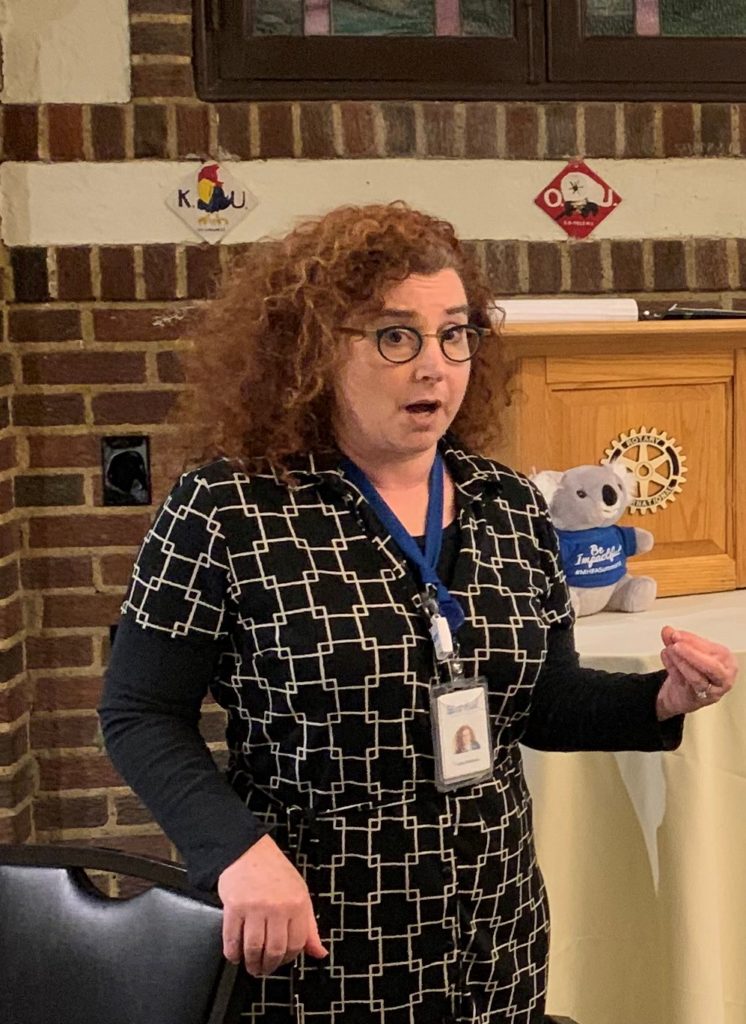
Leticia Cole stands with sponsor Steve Lane during her induction into Lawrence Central Rotary.
Leticia has worked for Paul Werner Architects for over 11 years. She is a 2014 graduate of Leadership Lawrence and has been a board member of Catch-A-Break for the past two years.
On behalf of all of us at Lawrence Central Rotary, a big thank you!
On Saturday we hosted the 2nd ride of our “Community Bike Ride” initiative. In spite of warm weather, overlap with the KU football game, and a variety of other options, we were able to total 79 participants (by counting the waivers). We had another successful helmet giveaway – as well as providing neon safety vests and shirts.
For the year (both rides), we had 247 participants, we gave away 107 helmets, 98 vests, and 105 shirts (with shirt and vest totals only limited by our inventory). And, importantly, we had another successful year without injuries. We heard multiple people share that it was “…my first time on this trail!” and more than one family share that they were back with kids who had graduated from our training-wheel takeoff clinic (that Jane Huesemann leads).
Speaking for the group – each time we help fit a child (or adult) with a helmet – provide them with a bright (neon) vest or bright shirt – we know we are proactively promoting well being (safety). It means a lot to us – and we could not pull this off without your help.
Below is a gallery of pictures (thank you Lynn O’Neal, Tobin Neis, and the folks at Friends of Lawrence Area Trails). Our fall ride that started at the Haskell Stadium parking lot and went up along the Burroughs Creek trail and back.
We are looking forward to coming back in 2019 and we hope you choose to be along for the ride!
Eileen Horn, State Representative for the 10th District, highlighted action during the 2018 session of the Kansas legislature. Horn, a Democrat, was appointed to fill the House seat vacated by John Wilson in August 2017. She worked as the sustainability coordinator for the City of Lawrence and Douglas County until December 2017 when she resigned to focus on her legislative responsibilities.
Although State revenues have begun to surpass projections in recent quarters, Horn noted that state taxes are still lower than in 2012. She explained that after nine rounds of tax cuts, however, there were holes in the State budget that the legislature has had to address.
During its session last winter, the legislature found additional money for transportation projects, K-12 education, and child and family needs. The State is catching up on its contributions to KPERS. Higher education received 2% back from a prior cut. The State’s water plan is funded now. The judiciary and corrections each received money for staff. Telemedicine was approved.
Kansas has ongoing financial challenges, however, especially in K-12 eduction. In June, the State Supreme Court ruled that while the State’s new plan for funding education was now “equitable,” it was still not “adequate.”
Horn ways that the most rewarding part of her new work is to be able to help constituents with their problems. Her biggest frustration is that the schedule of the session and the low stipend mean that legislature is skewed to include those who are older and independently wealthy, that is, those who can afford the time and money to serve.
Denise Ogilvie from Catholic Charities of Northeast Kansas knows what refugees face when they are starting over their lives. The organization’s refugee and immigration services, which is qualified through the State Department, provides refugee resettlement and support.
Ogilvie explained that their team is given 24 hours notice when a new refugee family will be arriving. Most refugees have been in a camp for 10 or more years. “Families come here with children that were born in a camp and are now college age. The children have never lived anywhere else.”
The Catholic Charities team meets the families at the airport and takes them to an apartment outfitted with all the basics they will need to start their new life.
With funding from the State Department, Catholic Charities works together with the families for six months to find employment and help them get settled. Thanks to the New Roots for Refugees program, support no longer ends there. New Roots builds on the strengths and experience that the refugees already possess, helping them start their own small farm businesses growing and selling vegetables. This means that refugee families can continue to support themselves and their families with the agricultural skills they gained in their native country.
“For many, this was their sole source of income in their original country. With a plot to farm, they now grow food they may not have eaten before.” The program also provides resources on how to market the produce that is grown and how to manage their finance and business.
The programs current plot in Juniper Gardens in KC Kansas provides everyone in the program with a one acre plot. Produce is sold in 27 farmers markets and restaurants. The program lasts for four years. Currently 85 percent of participants purchase a small plot of land to keep farming after completing the program.
“We try to not only help people in the middle of crisis,” said Ogilvie. “We believe in order to give dignity we need to help people stand on their own two feet so they are self sufficient.”
The next time it’s overcast, you may think differently about the sun’s rays. Kansas is currently one of the top ten states for solar power, either “slightly above or below Florida, depending on who you ask,” says Andy Rondon from Good Energy Solutions.
Rondon is living “every solar guy’s dream.” He was originally trained as a civil engineer and recently received his NABCEP certification, which is the solar industry’s leading recognition of technical sales expertise. He proudly drives a solar-powered car and nestles under his solar roof each night.
Rondon’s work at Good Energy Solutions paves a way for residential and commercial clients to take advantage of solar energy. Good Energy Solutions, based out of Lawrence, was named one of the top 25 solar contractors nationwide by Solar Power World Magazine and installed the most solar in Kansas in 2017.
Rondon explained that there are two types of energy production: Centralized and Distributed. Centralized energy production is the status quo, with large energy plants powering multiple cities. Solar breaks this model, with energy being made and used in the same area. “Creating energy where it is being used means you don’t need to have transmission lines as we have now. It changes the infrastructure that’s needed.”
The core of solar technology has not changed significantly since 1989. “We’re just better at manufacturing it,” says Rondon. Instead, the majority of research and development dollars are being spent on improving battery technology. “Once we do batteries better, we don’t need coal or natural gas. When this happens the world is going to be a lot different,” says Rondon. “The amount of energy dumped on the planet is mind-boggling.”
Solar modules last 20 years with a 30 to 40-year potential. Current rates mean it takes about 10 years for a customer to get their money back. New potential rates could push that to 15 years.
That shouldn’t deter potential customers. To the question of “Why go solar now if there will be a new technology in the next five to 10 years, Rondon replied “If you are generating all or most of your own energy now, what is the benefit of the next technology? You already have that.”