Category: News

  • Kansas Advocates for Better Care (KABC) Visits Lawrence Central

    Color-Logo-20151-300x165Mitzi McFatrich  executive director of Kansas Advocates for Better Care (KABC) says she has “the best job in the world”  even though the word she uses the most in describing it is “challenging.”McFatrich who is a United Methodist minister, started working with the group when it was Kansas Improvement for Nursing Homes. Founded in Lawrence by a concerned citizens group headed by Petey Cerf and Harriet Nehring, as a statewide organization of volunteers,  there are 650 members across Kansas. The group advocates with the legislature for law changes that benefit  older people, works on upgrades in possibilities and hosts workshops.

    Mitzi McFatrichMcFatrich who is a United Methodist minister, started working with the group when it was Kansas Improvement for Nursing Homes. Founded in Lawrence by a concerned citizens group headed by Petey Cerf and Harriet Nehring, as a statewide organization of volunteers,  there are 650 members across Kansas. The group advocates with the legislature for law changes that benefit  older people, works on upgrades in possibilities and hosts workshops.

    “There are always new challenges,” she said, using her favorite word.  “We train law enforcement, social workers , bankers to identify, intervene and prevent elder abuse, neglect, and financial exploitation.

    “Another challenge,” McFatrich said  “is helping people pick long term care. Older adults want to age in place at home. Nobody wants to talk about nursing homes or go to one. We work to maintain people’s sense of self and their dignity. We help people through life’s transitions.”

    A priority of KABC  is also to monitor medical care  for older adults. They maintain a database on facilities in Kansas to see what medical care is available at which nursing homes, to help people avoid  medical interactions that cause problems, and to  record comments and opinions about elder care . They serve as ombudsmen for older citizens.

    “And when I see some of the results, McFatrich said, “this really is the best job in the world!”

  • Re-Invent Lawrence Wants You to “Retire TO something, Don’t Just Retire “From” Something.

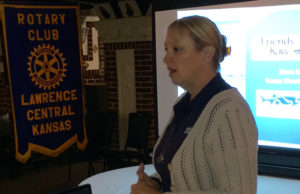
    JRETIRE-LOGOblowupudy Wright isn’t sure where this quotation came from, but she and others involved with the “Re-Invent Lawrence” initiative use is as their by-word.  Judy, a board member of Douglas County Senior Services, spoke about the local effort to attract retirees to Lawrence and asked club members to serve as ambassadors of the message.

    IMG_4659About three and a half years ago, the City of Lawrence and Douglas County established a task force to study what attracts retirees to Lawrence.  The hope was that by understanding the motivations of those who have come here to retire, others might be encouraged to follow.  DCSS was asked to lead this economic development initiative aimed at three market groups:  (1) Baby Boomers—to invite them to move back to the city where they attended a college or university; (2) adult children who live here—to ask them to encourage their parents to retire in Lawrence; and (3)  local pre-retirees—to entice them to stay in the community.

    The idea of retirement life in Lawrence is easy to sell.  The community has a lifestyle rich with art, theater, music, sports, and life-long learning opportunities.  Mass Street shopping, bike-friendly streets, parks and recreation options, libraries, and museums, and award-winning medical services are among the list of activities and amenities available here.  The City’s proximity to Kansas City and its international airport is also a decided advantage.

    Although it is difficult to track results of the DCSS efforts so far, Judy and Kay have been giving presentations in the community for about 14 months.  The DCSS office has received inquiries from potential residents during those months.  The organization has a distinguished list of sponsors and a robust website “Live Lawrence Life”  They are placing ads in the KU Magazine and other alumni communications.

  • Getting To Know Our Members

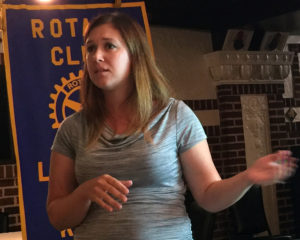
    Rotary 1Kate Campbell’s last meeting as president of Lawrence Central Rotary on June 29 reflected a theme she has been emphasizing all year—“Getting to Know You.”

    A panel of new members, Taryn Parillo and Jay Holley, and long time members, Glenn Davis and Lynn O’Neal, talked about their jobs, their hobbies, and their favorite things.

    “I think the deepening friendships are what has made the comradery at the meetings so evident,” Kate said. “One of my favorite things has been watching people get to know each other. Building relationships was one of the reasons we set up potlucks that included spouses and children. And attendance at the holiday luncheon, the anniversary dinner, and the Family Frolic Picnic reinforced new friendships. At every meeting we each put in ‘Happy Money’ and talk about things that have happened during the week.“

    On the 29th all four Rotarians told about their love for family gatherings, Christmas for Taryn and the fourth of July for Jay (although “we set the barn on fire with Getting to Know Lawrence Central Rotary's new and established membersfireworks once,” he said.) Lynn told about big family get togethers in Branson and Glen travels often with some of his five children.

    Differing in occupations, Taryn is a financial planner, Jay an architect, Glen in insurance, and Lynn a retired ophthalmologist, they have a common interest in community service that benefits Lawrence. Taryn said she especially enjoyed helping with the bike ride, while Jay talking about hearing about Rotary when members were planting flowers downtown. Glen, who said he is a “bike nut” has worked on several cycling projects over the years. Lynn said he joined Rotary for the friendships as well as the community service projects.

    “It has been so good this year to have members bring spouses, children, and grandchildren to our volunteer projects,” Kate said. “There are so many examples of this such as the Community Bike rides, Christmas bell ringing, and presentations from Sister Cities, to name a few.

    “Although fostering relationships was key, I’m also pleased that we continued all of our fundraising efforts and our international involvements’” she said.” Nearly everyone in the club has a project or has taken on responsibility for a particular task at some time during the year. And we’ve updated the ‘nuts and bolts’ for running the club by setting a budget, timely invoices, meeting notes and sending monthly Highlight emails.”

    As Kate turns the gavel over to incoming president, Jim Peters, all the panel members agreed that her “Getting to Know You” project, aided by her warm and welcoming personality, has definitely been a success.

  • Kansas Association for Justice’s Matt Birch Speaks to Lawrence Central

    bio_Matt_BirchFairness.  Impartiality.  These attributes are key to maintaining a court system that is respected by the public.  Matt Birch, attorney with Shamberg, Johnson & Berman in Kansas City, MO, and representative from the Kansas Association for Justice, spoke to Rotarians about the role of the judiciary on June 22. Birch began his comments by highlighting the division of power between legislative, administrative, and judicial branches that structures federal and state governments.  The courts were devised to stand independent of politics, serving as a check and balance to the actions of the other two branches of government where individuals are elected to office.

    Birch began his comments by highlighting the division of power between legislative, administrative, and judicial branches that structures federal and state governments.  The courts were devised to stand independent of politics, serving as a check and balance to the actions of the other two branches of government where individuals are elected to office. The current method of appointing Supreme Court judges in Kansas is known as a “merit system.” It was established in 1958 in response to the infamous “triple play” that took place in Kansas in 1956.  Designed to separate judicial nominations from politics, the process uses a Supreme Court Nominating Commission made up of attorneys and other citizens to nominate three qualified people for the open seats on the court.  The Governor selects one of the three nominees to serve.

    The current method of appointing Supreme Court judges in Kansas is known as a “merit system.” It was established in 1958 in response to the infamous “triple play” that took place in Kansas in 1956.  Designed to separate judicial nominations from politics, the process uses a Supreme Court Nominating Commission made up of attorneys and other citizens to nominate three qualified people for the open seats on the court.  The Governor selects one of the three nominees to serve.Birch explained that the merit system method of selecting judges in Kansas is now being challenged in the state legislature.  Instead of the merit system, the proposal is for a “federal-style” model where the Governor would select the nominee to the Supreme Court, subject to senate confirmation.  Such a change to the selection procedure for Supreme Court judges will require an amendment to the Kansas State Constitution. This new procedure is already in place for the Kansas appellate courts, established under a statute passed in 2013.

    Birch explained that the merit system method of selecting judges in Kansas is now being challenged in the state legislature.  Instead of the merit system, the proposal is for a “federal-style” model where the Governor would select the nominee to the Supreme Court, subject to senate confirmation.  Such a change to the selection procedure for Supreme Court judges will require an amendment to the Kansas State Constitution. This new procedure is already in place for the Kansas appellate courts, established under a statute passed in 2013.Matt Birch noted that this fall five Supreme Court judges will be on the state ballot in a routine retention election.  Professional ethics prevents them from  “campaigning” or defending their records in any way.  Birch urged voters to avoid being influenced by whether or not these judges had made decisions that were popular with the public and instead to assess each of the five judges according to their professionalism, ethics, and legal credentials.

    Matt Birch noted that this fall five Supreme Court judges will be on the state ballot in a routine retention election.  Professional ethics prevents them from  “campaigning” or defending their records in any way.  Birch urged voters to avoid being influenced by whether or not these judges had made decisions that were popular with the public and instead to assess each of the five judges according to their professionalism, ethics, and legal credentials.

  • New Lawrence City Manager Tom Markus Visits Lawrence Central

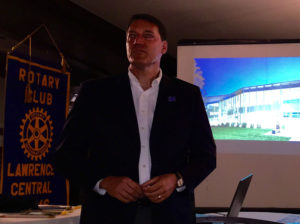
    Tom-MarkusNew Lawrence City Manager Tom Markus began his talk to Lawrence Central Rotary on June 17 by detailing his experience in the job. Beginning his career in 1973, he weathered 11 years in Cook County, Illinois, several years in Minnesota and, most recently, the top city job in Iowa City, Iowa.

    “In Cook County, I learned how to keep a moral compass; in Minnesota, I was working in a state governed at that time by wrestler Jesse “the body” Ventura; in Iowa, I learned about life in a university town,” he said.  “All these experiences have shaped me, made me more patient and calm.”

    But he knows he’s going to need all his experience and patience and a calm attitude in his new job. Markus said when he came to Lawrence he had an ambitious 100-day plan. “But I didn’t realize how complex Lawrence is.”

    Now he is working to balance expenses and revenues in light of  the city’s potential for a $1.3 million deficit in 2017. He said some of the options are to raise revenue or cut expenses, but his preference is a middle ground of mixing and matching from both options.

    “It’s close to the bone on decisions here,” he told Central Rotarians.  “The city has to provide core services such as police, education.  That’s essential.

    “Federal and state government have shed their support for certain services which means we are going to have to handle them locally. Although,” he said “that’s not bad because the distance from services support can be too long. When it’s local, common sense can come into play.” He believes the new city commission has a good impact on budget planning.

    “What I’m trying to do is figure how to settle the controversy, avoid polarization, and get to the middle,” he said.