The meeting was buzzing with anticipation and bee puns were “flying” as bee man Phil Knaus brought us up to date on domestic honey bees.
Knaus knows his bee lore as owner of Cedar Ridge Bees in Overbrook, Kansas. The business is not about producing commercial honey; rather the focus is on breeding and marketing bees for beginning bee keepers. Toward that end, he also offers beginner classes and support.
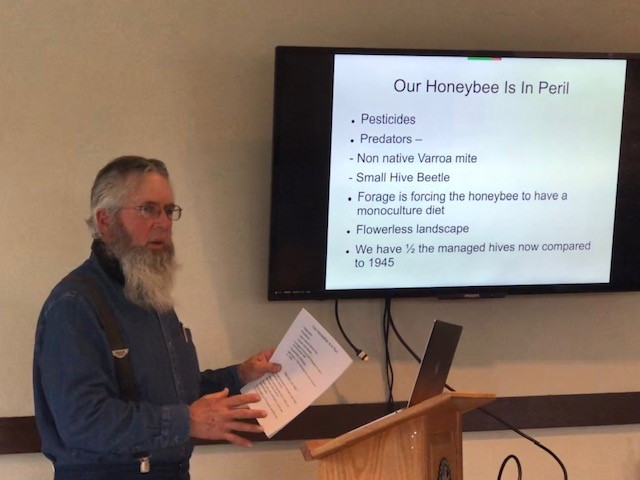
Most everyone likes honey, but there are other important reasons to care about bees. One third of our food supply depends on the work of these pollinators, as does some twenty billion dollars of the agriculture industry. Unfortunately, bees are in peril, as there are only half the bees in the country as there were in 1945. The indiscriminate use of pesticides continues to kill bees. Natural and invasive predators are a threat, like varroa mites and small hive beetles. Mono culture agriculture and flowerless landscaping reduces the food supply for bees.
Bees are altogether fascinating, and their hives are models of efficiency and cooperation. The queen is the sole mother of the hive. She mates once on a flight outside of the hive and spends the rest of her life providing eggs. She is productive for about two years. As she begins to fail, the colony produces a new queen.
The hive is mostly made up of female worker bees who have a short life span. Some workers fly as far as two or three miles to harvest nectar and pollen which is stored as food for the hive. Other workers maintain the hive, building honey comb, caring for young bees and defending the hive. The third group of bees are the male drones who have little responsibility after the mating flight. However, their presence has a calming effect on the hive.
Bees survive the coldest winters by forming a compact ball and taking turns to be in the warm center. Bees manufacture a substance called propolis which is a kind of bee glue for repairing the hive. Local honey can provide allergy relief, and bee stings are used to treat arthritis. Honey contains natural preservatives and is used in lotions and lip balms, and bees wax is used in candle making.
Fortunately, there are ways to help bees to prosper. Mitigating the damage done by pesticides is critical. We can also plant pollinators and build special bee gardens. Trees are also an important food source. Knaus urges us to buy local and support efforts to educate everyone about the value of bees.