Author: Fred Atchison

  • John Brown: Terrorist or Martyr?

    On Wednesday, October 13, a group of Rotarians and their guests toured the Encountering John Brown exhibit at Watkins Museum.  LCR is one of the sponsoring partners of the exhibit which will be open noon to 8:00 p.m. through November 6. 

    The exhibit tells the story of the radical abolitionist John Brown by utilizing first-hand accounts and illustrations from his time period.  Kansas artist Brad Sneed created large illustrated panels which serve to emphasize significant points in his story. 

    Brown grew up in Ohio where he encountered strong abolitionist ideas.  He came to believe that he was an instrument of God in the fight against slavery and that violence was a just response.  Brown married Dianthe Lusk, and together they had seven children.  He worked as a tanner and a stock man through out his life, and was not always successful in business.  Brown also lived in Pennsylvania and Massachusetts and became involved in the underground railroad.  In 1883 he married Mary Ann Day, and they had 13 more children. 

    In 1856, Brown moved to Kansas to engage in the fight to keep slavery out of the territory.  He lead a bloody reprisal raid on a pro-slavery family near Potawatomie and fought in skirmishes at Black Jack and Osawatomie.  Brown then led an 1859 raid on the federal arsenal at Harpers Ferry, Virginia, hoping to spark a slave rebellion.  However, Brown was captured and several of his party were killed. 

    Brown’s trial and execution gained national attention.  His actions inflamed the South and emboldened abolitionist, pushing the nation closer to war. 

    At a meeting after the tour, Rotary members commented on the variety of Brown’s life experiences and on the number of famous people he encountered along the way (Frederick Douglas, Sojourner Truth, Robert E. Lee).  There was a good discussion about whether Brown was a martyr or a terrorist.  The jury is still out on that point, but there is no doubt that John Brown had a huge impact on his time.

  • Aquifer in Peril

    The Ogallala Aquifer is a remarkable natural resource that lies under eight states in the high plains, including Kansas.  The aquifer makes up an area of some 174,000 square miles in the heart of the country.  The name comes from the underlying geologic strata that serves as an ideal subterranean catch basin for rain water that seeps into the ground. 

    “Crisis on the High Plains”, an article by Jeremy Frankel, and a CBS news report video provided our program. 

    The use of central pivot irrigation after World War II provided a great boost to agriculture in the region.  Today the aquifer is the source of 27% of irrigation in the United States and provides drinking water for 2.3 million people.  This remarkable resource is now in danger from agricultural chemical pollution and over extraction.  The depth of the aquifer varies from 400 to 1,400 feet and every year the depth drops several feet due to overuse.  The aquifer is recharged by annual rainfall that slowly seeps into the ground.  Presently extraction far outpaces the rate of renewal.  Agricultural chemicals have polluted portions of the aquifer.  At the present rate, the aquifer will be depleted and unusable before the end of the century, creating an economic disaster. 

    Scientist believe that changes in agricultural practices and other conservation measures could extend the life of the Ogallala considerably.  Some farmers have adopted dry land farming techniques that require less irrigation.  Scientist and environmentalists call for a dramatic change in the culture of agriculture. 

    Farmers disagree about how best to address the problem.  Some states have begun to implement regulations intended to reduce the depletion of the aquifer, but other states are taking a voluntary compliance policy with conservation measures.  Time will tell if the Ogallala Aquifer can be saved.

  • Pedestrian/Cycle Bridge Proposed

    Steve Evans, retired architect and member of the City’s Multi-Modal Transportation Committee, introduced a proposal for a new pedestrian/cyclist bridge crossing over the Kansas River.  Steve, an avid cyclist and resident of North Lawrence, has long had concerns about pedestrian and cyclist safety on the bridges crossing the river.  He and other people who shared his concerns formed a work group called RiverFront & Center to discuss the issue. 

    Steve explained how the present walkways on the bridges are narrow and congested. The southern end of both bridges are particularly hazardous for pedestrian and cyclist traffic.  The work group developed a new bridge proposal that not only could solve congestion and safety issues but also serve as an aesthetic asset for the river front area.

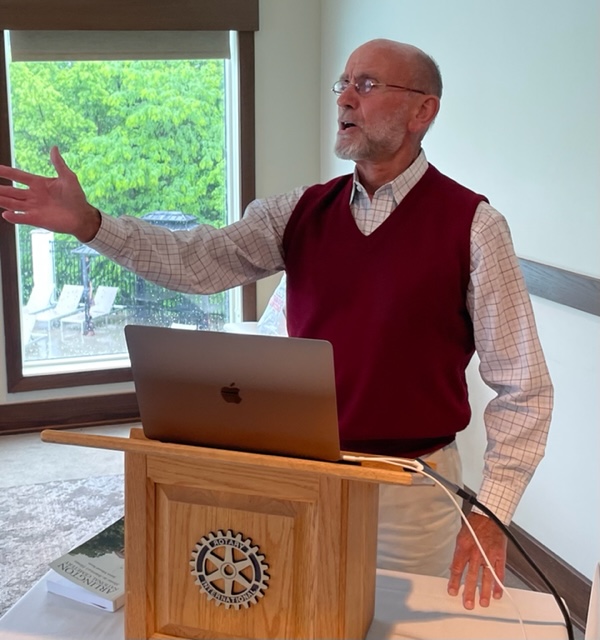
    Kent Williams describes options

    Kent Williams, an artist, architect, and urban aesthetics collaborator, presented several illustrations and details on three possible bridge designs.  Kent spoke of the historical importance of the riverfront area and of the great potential for making it a focus of development and activities as many other communities have done.  All of the proposed designs would be ADA accessible and connect with the Lawrence Loop trail, the downtown, City Hall, green space and parks, and other cultural amenities. 

    Also in attendance in support of the new bridge concept was Sujoy Dhar, an architect and urban designer, and City Commissioner Courtney Shipley.  The City Commission will hear a presentation on the Kaw River Commons bridge concept on September 21st.

  • Rotary Nurtures Future Leaders

    Rotary Youth Leadership Awakening (RYLA) winner Ian Rhea and his mother Joy Rhea were guests at the August 18 meeting of Lawrence Central Rotary.

    Each summer Lawrence Central Rotary sponsors a high school student to attend RYLA, an intense leadership training experience held on the campus of Kansas University.  Local leaders presented information and moderated activities for the student participants. Leadership presentations included learning about civic engagement, Rotary Youth Exchange, and Rotary, Rotaract and Interact.

    Although RYLA was conducted by Zoom this year due to the pandemic, there were some in-person events: rock climbing, and tours of the Dole Institute and the Lied Center.   Participants did a small group problem-solving exercise about creating strategies for addressing the “brain drain” in Kansas.  They also did a service project:  putting together and distributing hygiene kits.

    Ian will be a high school sophomore this fall and hopes to be a fire fighter some day. He is active in student council and marching band, volunteers at the local food bank, belongs to 4-H and participates in church activities.  Ian reported that the best part of the experience was interacting with the other kids.  He added that RYLA made him think about the importance of public service.

    Hearing from RYLA students always makes for a popular program.  Thanks to Leticia  Cole for her work recruiting and coordinating with our RYLA winners.

  • Face-to-Face Meeting Focuses on Polio Plus

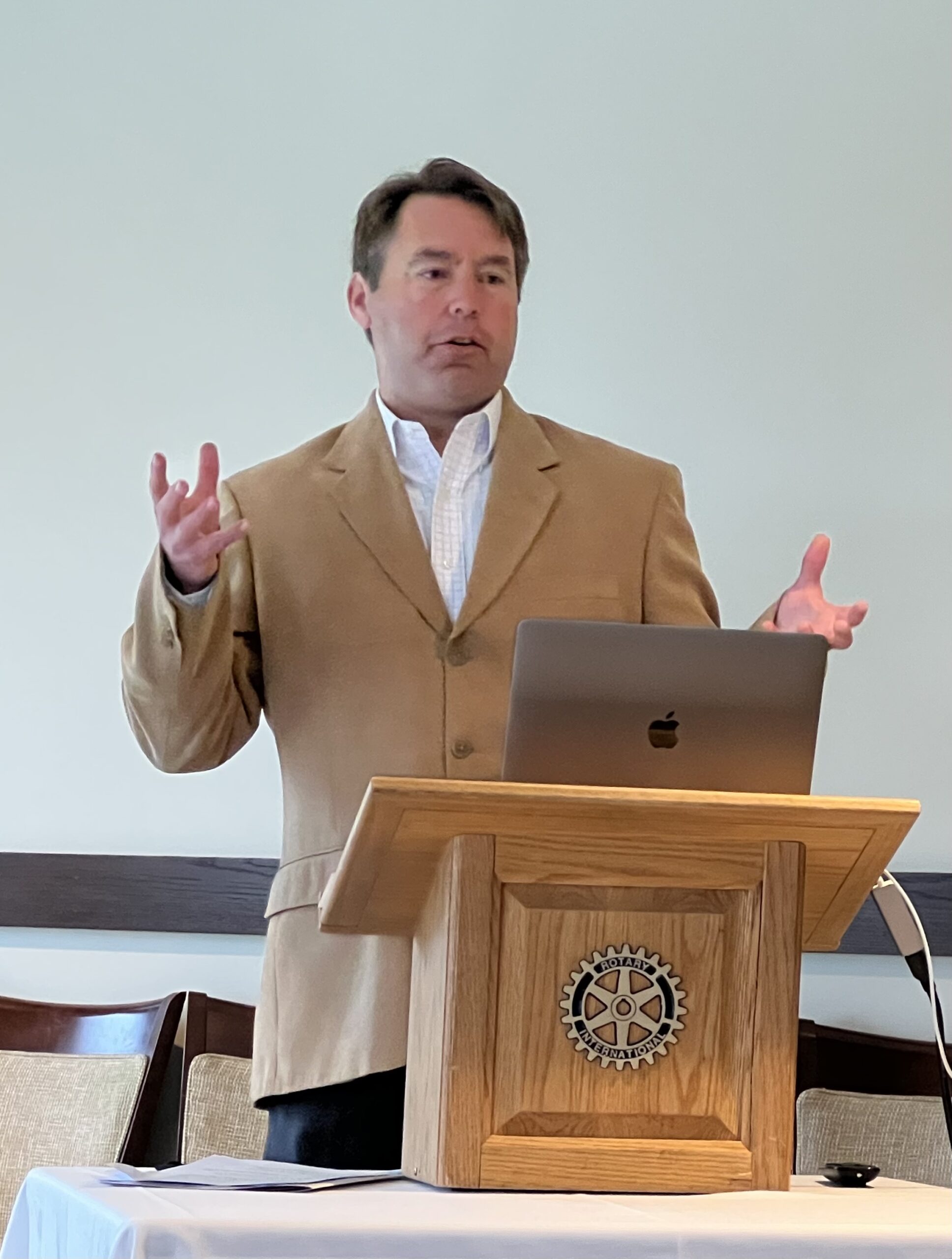
    Kyle Haugen shares his experiences with the Polio Plus effort

    Kyle Haugen, a member of the Prior Lake , Minnesota Rotary Club, provided an update on Rotary’s efforts to eradicate polio at the club’s first face-to-face meeting in many months.  Kyle comes from a family of Rotarians and has served as a former District Governor.  He has been active for a number of years in the End Polio Now project raising funds and advocating for the cause.  Kyle shared his personal experience of traveling to India in 2019 to participate in an immunization drive.  

    Rotary’s commitment to eradicating polio started with a grant in 1979 to immunize the children of the Philippines.  Out of that initial effort, the Global Eradication Initiative was created.  In 2007, the Gates Foundation joined the cause, pledging to spend two dollars for every dollar spent by Rotary.  

    The eradication effort has utilized 20 million volunteers working in 200 countries.  Some 15 billion dollars has been spent, and spectacular success has been achieved.  The focus is now on Pakistan, where there have been no new cases since January, and Afghanistan where there are only a handful of remains cases. 

    Polio Plus needs continuing assistance to finish the job and to provide related health measures in countries at risk, but the goal of eradication is truly within reach.                                                                                                     

    The mood was celebratory as Lawrence Central Rotary met face-to-face for the first time in many months.  Members wore masks except when they were eating, other wise it was business as usual.  Thanks to the good work of the ad hoc technology committee, a new computer and camera system was employed.  The new equipment makes it possible for members and future speakers who can’t attend in person to participate in a meeting.