Category: News
-
Guatamala Literacy Project Sets a Gold Standard
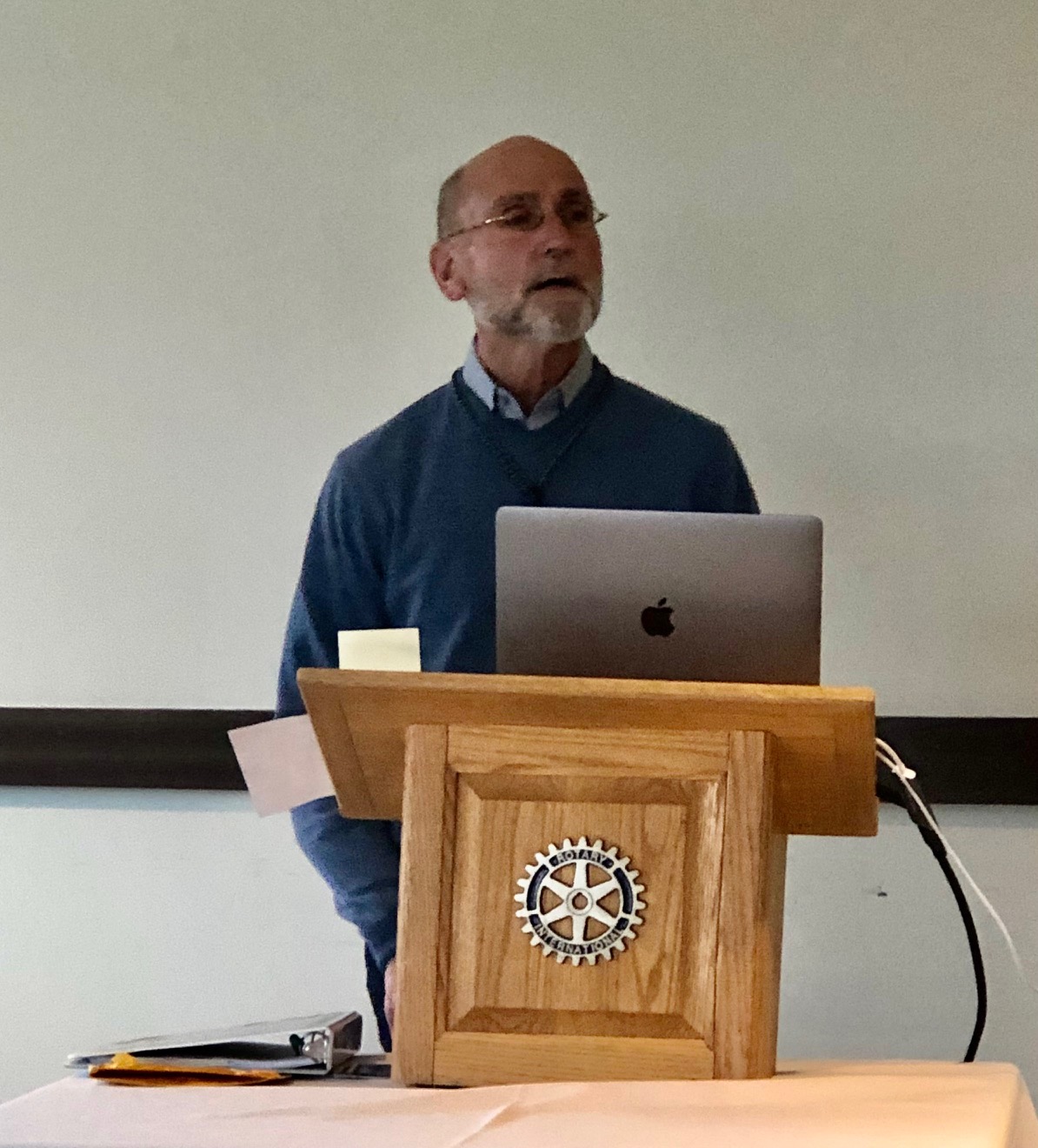
Joe Berninger, member of Ohio Pathways Rotary Club, spoke to us about his club and their work with the Guatemala Literacy Project (GLP).
Joe, a Cincinnati resident, explained that he belongs to an e-club in District 6600. They are a diverse membership of about 30 with active Rotarians in many different countries. The club is a good fit for people who have to travel and have challenging schedules. Ohio Pathways Rotary was working with Zoom way before the pandemic.
The GLP is one of the largest grassroots, multi-club, multi-district international projects in Rotary. The effort includes 600 clubs in 80 districts and eight countries. In 2017, then-Rotary International President Ian Risley described GLP as the gold standard of Rotary projects for sustainability and impact.
The goal of the project is to improve education for under-served students. The need is great as Guatemala has the lowest literacy rate in Central America. Children are often pulled out of school for economic reasons and do not return. Guatemala is also the largest source of immigrants at the southern border of the United States.
The project provides reading instruction, text books, computer labs and scholarships. Some 750 scholarships worth $960 each have been distributed. When the project started in 1997, only one out of three Guatemalans could read. Presently, two out of three students can read. Local Rotarians assist with GLP by teaching job skills and other aspects of the program. Over 225,000 students have been served by GLP.
-
Close Encounters with History
Steve Nowak, Executive Director of the Watkins Museum of History , proudly explained that the Watkins was a “founding institution” for a new traveling exhibit about John Brown. “Encountering John Brown” is an appropriate initiative for the Watkins and for Lawrence because Brown’s experiences here were significant in forming his philosophy and actions as an abolitionist.
John Brown was notorious for his activities on behalf of the abolition of slavery in the mid-1800s. It was while he was living in Lawrence that Brown realized that preaching abolition was not enough; he needed to take action. His work to transport slaves to freedom on the Underground Railroad are legendary. He fought at the Battle of Blackjack that took place near the present day Baldwin City before returning east to Virginia where he led the Harper’s Ferry slave uprising in 1859.
Developed by Overland Traveling Exhibits, the self-guided exhibit highlights the influences and episodes in John Brown’s life that formed his career as an abolitionist. Visitors will read narratives and view portraits of Brown and other key individuals of the era. The portraits are created by artist Brad Sneed.
Work on the exhibit began in 2019, but the fall 2020 opening was delayed due to the pandemic. Funded by grants from the City of Lawrence, Watkins eagerly accepted the challenge of staging a traveling exhibit even though the Museum had never made space for such a display in the past. The display will be situated in the Community Room of the museum for two months from September to early November. Nowak estimates that it will move to new locations around the country over the next two or three years. The Watkins Museum will continue to be highlights as a founding institution .
The project has a wealth of partnerships supporting it. To welcome the potential increase in tourism, ExploreLawrence is coordinating bus tours and developing a brochure about other local sites of interest. Blackjack Battlefield and the Lecompton Historical Society are making similar plans. The Lawrence Arts Center will feature an exhibit about segregation coincident with the exhibit. Theatre Lawrence will stage “The Ballad of Blackjack” this fall.
-
Tacha’s Career Advice? “Don’t Plan Too Much”
Hon. Deanell Reece Tacha (Ret.) has led a fascinating life. The key to her journey? She says firmly: “Don’t plan too much.” Too many people think they know exactly they want in life and set out to get it, but Tacha found that the best experiences came when she let life lead her.
Judge Tacha grew up in Kansas and earned her B.A. at the University of Kansas. After she completed law school in Michigan and spent some years working in Washington D.C. during the Nixon administration, she faced the choice to stay in the East or to return to her home state. Beckoning her back was marriage to a fellow she had known for a long time.
Tacha decided to return and reports that she has never regretted her choice. But she did find herself facing a professional challenge: she could not get a job as an attorney in small-town Kansas. Finally she found someone with whom to share an office in Concordia, KS, and hung out her own shingle. Practicing law and raising a young family meant she learned to “set priorities and follow them,” says Tacha.
Eventually, Tacha moved to Lawrence and joined the law faculty at KU. She became Vice Chancellor of Academic Affairs there. In 1985, Ronald Reagan appointed her to the US Court of Appeals for the Tenth Circuit where she served for 20 years, including seven years as Chief Judge of the court.
Being a judge was the “best,” according to Tacha. She describes her job as straightforward, if not easy: “Do the right thing.” She loved her colleagues in the judicial system; they were brilliant, kind, and thoughtful people. The worst thing about being a judge was the confining nature of the work. Ethically, she could not talk about anything related to her cases, and she could not raise money for causes she believed in. More than anything, she found she missed being with young people.
To reconnect to the younger generation, Tacha took another unanticipated career turn. After she retired from the federal bench in 2011, she accepted the role of Dean of the Law School at Pepperdine University. Again, she enjoyed her work thoroughly, but after five years, the traffic and crowds in California and the distance from her husband who remained in Kansas called her back home.
Now Tacha is focused on activities in Lawrence. She is on the boards of DCCF, Watkins Museum, and Freedom Frontier. In addition, she does a few mediations for disputes within JAMS.
Tacha commented about a few “notable moments” during her judicial career. On the morning of 9/11/2001, for example, she was in a conference room at SCOTUS with a number of other justices. The meeting began promptly at 9:00 a.m., chaired by Chief Justice Rehnquist. With the hour, they all were evacuated because of the attacks on New York City and Washington, D.C. She ended up spending seven hours in isolation in the basement of her hotel that day, hidden from potential danger.
When Tacha worked for the 10th Circuit court, many cases involved use of public lands in the six states under that jurisdiction. She chuckles when she declares that she probably knows more about wolves than most people because she had to rule more than once about their status as a protected species. Tacha acknowledges the huge role that falls to the courts to make decisions about the extent and appropriateness of administrative regulations of all kinds. The statutes themselves are usually not specific when passed through Congress, so administrative regulation creates “invisible law.” The courts then interpret and evaluate the regulations, making judgments to balance the amount of control a federal agency has in a situation against potential overstep.
Death penalty cases were especially stressful. Tacha says she coped with the weight of such decisions by reminding herself that she needed to focus on following the rules of the applicable law, not to make judgments about the cases that brought particular individuals to death row.
When asked for opinions, Tacha remains very careful about choosing her words. She did declare, when asked, that she would prefer stability rather than changes in the structure of the Supreme Court.
-
Kansas State Librarian Oversees Multiple Resources
Eric Norris, the 17th State Librarian of Kansas, spoke on the history and services of the State Library. The State Librarian serves at the pleasure of the Governor, although traditionally the position has not been treated as a political appointment.
The State Library began as a traveling territorial library and became formally established with statehood in 1861. Now located on the third floor, north wing of the State Capitol Building in Topeka, the State library has been restored in appearance to its original architectural elements.
The modern State Library serves a reference function for the public and state government. It maintains the Kansas Government Information data base (KGI) along with a legislative hotline that provides the content and status of bills and statutes. There are numerous other information databases and extensive information available on Kansas libraries. Various educational resources, e-books and audio books are available on line. The State Library administers a Talking Books service which provides free resources to any Kansan who cannot read regular print. It also features an annual list of Kansas Notable Books which showcases 15 of the best new books about Kansas or written by Kansas authors.
The State Library works closely with all the libraries in the state, including seven regional library systems, providing continuing education for librarians and trustees. It distributes an annual grant to rural libraries, coordinates an inter-library loan network, and provides expertise on Kansas library law to library directors and library boards.
Public access to the the State Library was curtailed during the pandemic, but online services were maintained. Plans for fully opening the State Capitol Building are in the works. A complete listing of resources and services are available on the State Library website.
Eric grew up in Hays, KS, and attended Kansas University as an undergraduate. He earned an MA at Fort Hays State and an MLS at the University of Wisconsin, Milwaukee. Eric has served as head of Hays Public Library and has also worked in human resources and as a journalist. Eric has family in Lawrence where he resides.