Category: News

  • Dialogue that Builds Bridges at ECM

    Ecumenical Campus Ministries “offers welcoming and neutral spaces where the KU and Lawrence communities can open their hearts, minds, and spirits to one another,” according to Kim Brooks, Executive Director. ECM is well-located for this purpose at 1204 Oread Avenue, just across the street from the KU campus.  Supported by various Lawrence churches as well as individual contributors, the organization seeks to establish “dialogue that builds bridges” and focuses on providing answers to questions regarding vocation and career, sexuality, global and environmental justice, faith dynamics, cross-cultural awareness, and hospitality.

    A variety of gatherings encourage the dialogue, in particular the Interfaith Café, an informal discussion about life issues, and the long-standing University/Community Forum, a free talk on various topics that takes place every Wednesday at noon. ECM also maintains the Solidarity Library on its main floor, a collection of progressive books, journals, films, and magazines.

    ECM serves the body as well as well as the mind by hosting a food pantry and a Thrifty Closet of clothing and household items. Veggie Lunch, Soup and Song, Tai Chi and Chai Tea, and Yoga–Pure and Simple are all on the calendar this fall.  In addition, the facility will soon open its hostel, a dormitory-type space with bunk beds that can be rented by the day for a low cost.

  • “Keep Calm and Hope It’s Not Cloudy”

    The solar eclipse that will occur on August 21, 2017, is rare.  It is the first eclipse to even touch the United States since 1979.  The last eclipse to cross the United States occured in 1918.  The United States is the only country that will be touched by this eclipse. It is the first eclipse that is exclusive to the United States.  A total eclipse of the sun will occur in Lawrence every 400 years or so, according to Dr. Dave Besson, KU Physics professor and astronomy enthusiast.

    Besson explained that the view of the eclipse in Lawrence will be only 98% “totality” as the lunar shadow slides across the sun.  Many people are expected to travel to locations where they can see “totality,” a point where the sun is completely eclipsed by the moon.  The path of totality will be about 70 miles wide, arcing across the United States from the Northwest to the Southeast.  The eclipse will sail across Oregon, Wyoming, and Nebraska, cut across a corner of Kansas, go over Missouri, and parts of Kentucky, Tennessee, and Georgia, and then pass over South Carolina.  Moving at 1,000 miles per hour, the eclipse totality will last about two-and-a-half minutes at any particular point on the path of totality.

    The phenomenon of total eclipse is rare because the earth and the moon are on different planes relative to the sun, Besson explained.  Eclipses occur when the moon is closest to earth.  Since the moon is receding from the earth by .8 cm/year and the earth’s spin is slowing down, eclipses will happen less often in the future.  Besson’s advice?  “Keep calm and hope it’s not cloudy.”

  • Sunrise Project Grows More than Gardens

    Gardens. Orchards. Cooking. Worms. All are ingredients to connecting people to good food, community and the environment, according to Emily Hampton, Executive Director, and Melissa Freiburger, Director of Programs, at Sunrise Project.

    Sunrise Project is an effort to “empower people to live healthy, self-determined lives through engagement with food and the environment to build a socially just community.” It’s a significant challenge, as some people in Lawrence do not know much about where food comes from or how to prepare it to eat.

    The non-profit organization is developing a center that includes workshop space, a community kitchen, and gardens. The group has also planted a small orchard. Community members are invited to enjoy the harvest by picking what they need to bring home.

    Healthy Sprouts provides programming to child care centers and in-home daycares that includes gardens, food-based curriculum, family engagement and farm connections. For older children, Sunrise facilitates a cooking and gardening club at Cordley Elementary and a cooking club at New York Elementary. Sunrise is also building a worm bin to demonstrate vermicomposting, the process of composting using worms.

    In addition to its outreach to young people, Sunrise Project has partnered with Lawrence-Douglas County Health Department to develop a health equity model. Eight Community Coordinators were hired and trained in food systems, local policy and civic engagement. They then went out to gather everyday stories and experiences with food in Douglas County. Those stories were incorporated in the Food Plan that will inform future decisions in the county for years to come.

    Ray, son of Lawrence Central Rotarian Audrey Coleman, stands with his sister Zea after the club meeting they attended with their mom. Ray was so inspired that he drew apples, cherries, and a tree while listening to the presentation.  The Sunrise Project hit its mark!

  • Inspired to Action at 2017 RI Convention and Peace Conference

    No one can do it alone.

    This theme inspired 40,000 Rotarians to action at the Rotary International Convention and the Presidential Peace Conference in Atlanta, GA, in June.  Lawrence Central Rotarians Janis Bunker and Kate Campbell described their experiences at the event.

    • Dr. Bernice A. King, CEO of The King Center, declared: We are interconnected, inter-related, and “caught in a network of mutuality.” For one to win, all must win.
    • Amina J. Mohammed, Deputy Secretary-General of the United Nations, spoke of the moral imperative: Serve humanity and make a difference through direct action for results in people’s lives. To achieve prosperity and peace, no one can be left behind.
    • Philanthropist Bill Gates celebrated the successes of Rotary’s efforts to eradicate polio.
    • James Quincey, CEO of Coca-Cola, described partnerships between corporations and organizations like Rotary aimed at bettering the world.
    • Andrew Young, civil rights leader, congressman, and former mayor of Atlanta, described Rotary’s role: The glue to hold society together and the grease to help the world grow and change.
    • Jack Nicklaus, champion golfer and Polio Ambassador for Rotary, believes that success comes from focus and concentration; knowing yourself; and taking personal responsibility.

    In addition to the keynote presentations, numerous breakout sessions provided project ideas and resources to all who attended.

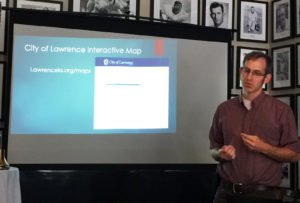
  • City of Lawrence Mapping Guru Micah Seybold Digs Maps

    Micah Seybold loved maps from an early age.  In university geography class he got serious about his interest and abandoned his plan to be a computer programmer.  However, his tech background did come in handy and lead to a GIS mapping job with the city of Lawrence.  Micah Seybold presides over a varied collection of digital maps, all of which are accessible by computer and even by smart phone.  The goals of his department include simplifying public access to city maps, eliminating the need for paper maps, and integrating GIS resources with business processes.  Each day he handles map and data information requests, catalogs related materials, performs spatial analysis, and strives to optimize workflow.  The use of digitalized maps and data saves time by creating efficiencies.  For example, digital maps may be used to design efficient service routes for transit or delivery of other services.  The city makes available a number of downloadable and interactive maps, including census tracts, bikeways, flood plains, crime, cemetery, tax districts, transit routes and more.  Users may customize maps by employing measurements, drawing on maps and even layering different maps.  Maps may be printed to PDF, JPG or other file formats.  All of these resources and assistance in using them are available at Lawrenceks.org/maps.