Blog

  • Anatomy of a Crisis

    The opioid crisis became personal for Tom Coleman when he took his elderly mother to see a new doctor. On reviewing her list of current medication the doctor expressed alarm at the number of high dosage potent drugs she was taking. Coleman was motivated by this experience to learn more about the opioid crisis.

    Coleman is a graduate of Washburn University and a retired federal contracting officer, working primarily on military construction projects. He decided to apply his skills to researching the problem. What he learned was appalling: in 2016 there were 53,000 overdose deaths due to opioids, and the price tag on misuse had reached eighty billion dollars.

    The trouble started when opioid use for cancer patients was expanded to treat any kind of chronic pain. Unprecedented advertising and financial incentives to regulators and doctors drove opioid prescription rates to increase ten times in the next decade. The Sackler family and Purdue Pharma were making billions. They lied about the threat of addiction and served up deceptive studies and research to increase sales. Opioids proved to be highly addictive and subject to serious abuse. Some users crushed pills and snorted them, others turned to heroin.

    Meanwhile, the Sackler family made huge gifts to museums, universities and other entities. A pattern of nefarious actions on their part have now been exposed and state governments are suing to recover damages incurred by the crisis.

    Unfortunately, while many pill mills have been shut down and unscrupulous doctors have been put out of business, the abuse and damages continue. Tom Coleman urges every one to be informed consumers when the seek relief for pain.

  • Lawrence’s 2019 Community Bike Ride Set for July 20th

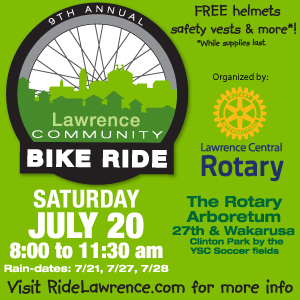
    The 2019 Community Bike Ride is set for July 20th.  We’ll again be at Lawrence’s Rotary Arboretum at 27th and Waukarusa.

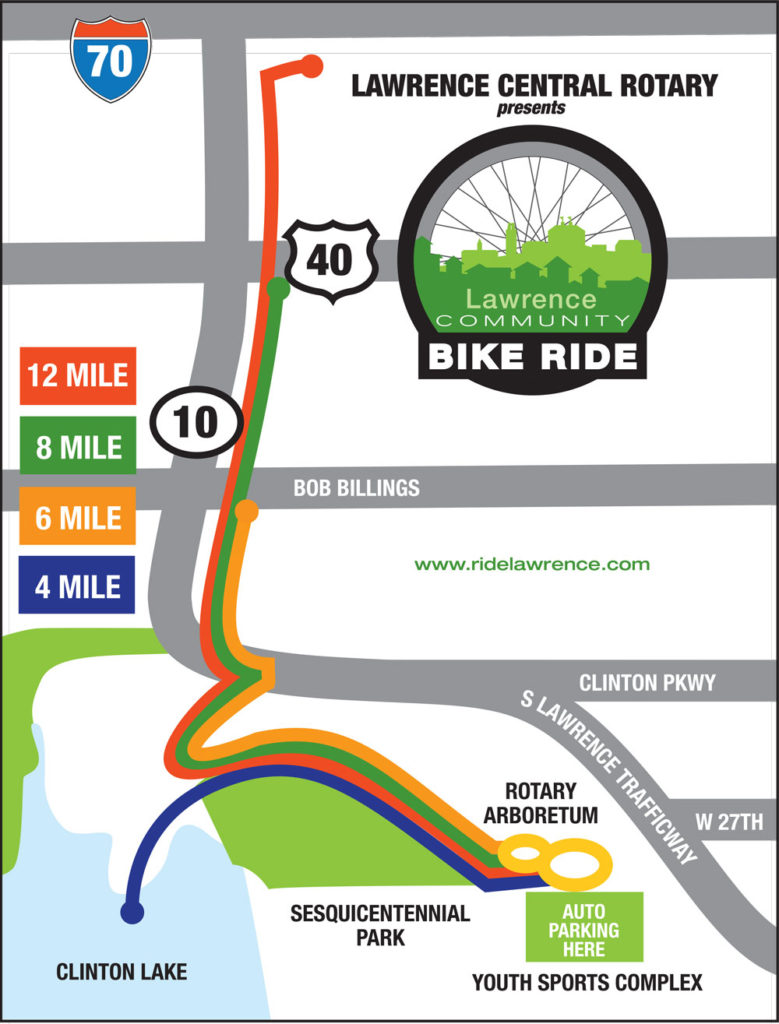
    This year we have 4 rides planned for folks of all ages and experience.

    • 4 Miles – 9:30 am – Sanders Mound
    • 6/8 Miles – 9:00 am-  K-10 Trail
    • 12 Miles – 8:30 am – I-70 Turnaround
    • 22 Miles – 8:00 am –  Lawrence Loop

    We are excited to again to be sponsoring free helmets, safety vest, and other exciting goodies (while supplies last).

    After a trial run last year, we will again be partnering with Lawrence’s bike share company VeoRide who will offer FREE bikes for use during the event if it is too difficult for you to get a bike to the Arboretum. You just need to register before 7/18 at http://bit.ly/cbr-bike-res

    All of this is made possible by volunteers from Lawrence Central Rotary and some fine local sponsors who love supporting getting outdoors and being active. 

    You are also welcome to join the ride after-party at S&S Artisan Pub and Coffee House at 2228 Iowa Street between 12 and 2pm.

    We will have releases on-site for attendees to sign when checking in, but you can also download one here to fill out and bring if you like.

    See you on July 20th!

    Updated Ride Maps!

    We’ve had some requests for maps so we’ve put this together for you. If you’d like to download a pdf of one use this link.

  • Discover “Secret London” with a Monopoly board

    Doveton shows the London map of Monopoly locations

    John Doveton, retired from the Kansas Geological Survey, has developed a reputation for his diverse and quirky expertise.  When he visited Lawrence Central Rotary recently, he has a secret to share.

    Doveton explained that people in the English-speaking world outside of the United States play a version of the board game Monopoly that uses place names of locations in London.  The American version uses places found in Atlantic City.

    The graphics and color scheme on the English game board are the same as the United States version, but the properties have different names.  For example, the familiar upscale properties called “Boardwalk” and “Park Place” in the American version of the game are called “Mayfair” and “Park Lane” in the London version.  The railroads include “Kings Cross,” not “Reading.”

    Doveton suggests that the next time people travel to London, they seek out the landmarks of Monopoly London.  Trekking to find them will lead to explorations in parts of the city that traditional tourists miss.  And the curious can uncover interesting historical tidbits.  For example, the US Liberty Bell was cast by a foundry near Whitechapel Road, a place name found on the game board.


  • Southwest Middle School Excels at Future City Competition

    For several years Southwest Middle School has participated in the Future City Competition, an engineering competition for 6th, 7th, and 8th graders. This year’s theme was “resilient power grids in natural disasters.” The students were required to design a city that could sustainably bounce back after a major weather event.

    In addition to support from their teacher, the students consulted with a professional engineering consultant.

    The project required the students to develop a model using SimCity, a software for designing a city. The students reflected how well the software worked at demonstrating the repercussions of city planning, such as the consequences of zoning and tax changes.

    The students were also required to write a 1,000 work essay explaining how transportation, housing and the electric grid in their city works to protect against natural disasters.

    The students constructed three-dimensional models of the city mostly out of trash. The students were given a budget of up to $100 per model.

    During competition the students delivered a seven-minute presentation. Both teams qualified for nationals; one team placed sixth overall at the national competition.

  • Artificial Intelligence: What Does it Mean to be Human

    Dave Mannering | Lawrence Central RotaryThe news is full of stores about artificial intelligence (AI) including self-driving cars and even facial recognition technology and its ethical application.  AI is also the subject of speculative science fiction and futuristic tracts.  Is the end of humanity at hand?  David Mannering provided a short history of AI and its potential to serve us.  Mannering’s background includes graduate study at KU, forty years of working in IT including service of fifteen years as chief information officer.  He also worked for the State of Kansas Department of Revenue and taught programming and information systems management.

    Mannering began with Alan Turing, a British mathematician, who developed a theory of computation while working on government security projects in World War ll.  He developed a binary system of communication that made machine driven computation possible.  Computing science and the idea of AI had to overcome huge obstacles in the early years.  In 1997 an IBM computer named Deep Blue defeated the reigning world chess champion.  Mannering stated this was not really AI at work but sophisticated programming.  True AI involves learning and not just the retrieval of information.  Still, Deep Blue got the world’s attention. 

    Ray Kurzweil captured the moment with his nonfiction work “The Singularity is Near” and we have been talking about what it means to be human ever since.  Is Mannering worried about where AI is headed?  He replied he would not lose sleep over AI as we have the power to determine its use.  Let us hope for responsible utilization of this amazing technology.