Blog

  • Open World Team from Ukraine Visit Lawrence Central Rotary

    Open World Leadership CenterWarm smiles. High energy. Endless enthusiasm. Poised professionalism. Fluent English.

    The members of the Open World team from Ukraine impressed everyone they met during their week-long stay in Lawrence. Lawrence Central Rotarians welcomed members of the Open World team from Ukraine to their meeting on September 28.

    The group of five educators, their facilitator, and an interpreter spent a week in Lawrence exploring the learning programs available here and in nearby communities. At Rotary meetings, each person on the team described his or her work and gave a reaction to what the team was seeing in the United States.

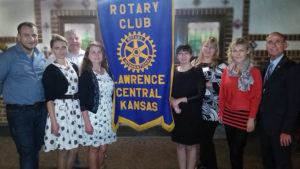
    Open World team from Ukraine 2016Left to right, the team members are pictured with Jim Peters, president of Lawrence Central Rotary:

    • Oleksandr Elkin led the presentations to Rotary clubs, first showing a brief video about Ukraine, its landscape, cities, and industries. Oleksandr also highlighted his work as chairman of “EdCamp Ukraine,” an international movement dedicated to professional development for teachers. On the trip, Oleks sought to find ideas to improve teacher development and to observe technology innovations in teaching methods.
    • Yaryna Datskiv works in a center that assesses educational quality for three regions of Ukraine. Her goal for the trip was to learn more about American secondary education standards and testing methodologies.
    • Vladimir Bassis, a Ukrainian who now lives and works in Des Moines, served as interpreter during the visit.
    • Oksana Puha teaches English at the post-secondary level. She came to learn about new developments in foreign language teaching.
    • Asia Zaiets is the principal of a school in a small town. She supervises over seventy teachers and 700 students (grades 1-11) all housed in one building. Asia is interested in innovation and in management techniques that will help her teaching staff grow.
    • Halyna Kaluzhna served as the facilitator for the group. Fluent in English, she also a teacher of English.
    • Oksana Domaratska is an elementary teacher in a school situated in a village outside Lutsk. Although she did not speak any English, she readily communicated her love of children, passion for culture and travel, and fascination with nature.
    • Jim Peters is president of Lawrence Central Rotary.

    The three Lawrence Rotary clubs cooperated to plan and implement the itinerary that the group followed. Activities included visits to alternative education settings, various K-12 buildings, and the district office in the Lawrence school district. They met faculty and administrative staff at area universities, colleges, and junior colleges. The team met local officials on the school board and in city, county and state governments. They spent a morning in Topeka touring the Kansas Statehouse and the Brown vs. Board of Education Museum. In between, they forged friendships with Rotarians at multiple social events and weekly Rotary meetings.

    The Open World Leadership Center program is an arm of the U.S. Congress. Its mission is to introduce young foreign leaders to the American democratic governing systems and free market operations at every level: federal, state, and local. According to Executive Director John M. O’Keefe, the program partners with service clubs such as Rotary to support Congressional interests to fulfill its mission to serve Members of Congress who desire to both better inform their own foreign policy formulation and inform other nations of U.S. values.

  • Lawrence’s Fall Community Bike Ride – A Great Time Had By All

    The weather was beautiful and around 100 riders and volunteers came out September 17th for the Lawrence Fall Community Bike Ride organized by Lawrence Central Rotary.  “We had everyone from novices and kids on training wheels to local professional riders come out,” said Central Rotary Club President Jim Peters, “our club rallies around these events and it’s great to be able to provide a safe and encouraging event for bike riding.

    Event chair Steve Lane coordinated volunteers and organized the sponsors from all over Lawrence. “Steve’s organization and prep for this function like a Swiss watch,” said club member Tobin Neis, “we wouldn’t be able to do it without him.

    Lawrence / Douglas Country Community Health Planner Charlie Bryan was on hand showing attendees the proposed “Lawrence Loop” bike / multi-use path.  LiveWell Lawrence and partners continue to advocate for finishing this 22-mile loop trail around Lawrence everyone could enjoy.

    Exciting for both local Rotarians as well as attendees to see was an assembled ShelterBox which Lawrence Central Rotarians have heavily supported over the years.  A ShelterBox is a simple and effective solution to deliver the essentials people need to survive and begin to rebuild their lives in the aftermath of a disaster.

    ShelterBoxes are tailored for the particular disaster being responded to, but typically includes a disaster relief tent for a family, thermal blankets and groundsheets, water storage and purification equipment, solar lamps, cooking utensils, a basic tool kit, mosquito nets and children’s activity pack.

    Thanks to all our sponsors and volunteers who made this happen!

  • A Stellar Home For Naismith’s Original Rules For Basketball

    curtish-marshFellow Rotarian Curtis Marsh, Director of Information and the DeBruce Center at KU, told the remarkable story of how James Naismith’s original 1891 rules for the game of basketball came to reside on campus.  Naismith invented the game to provide a rigorous indoor winter activity for the young athletes he worked with at a YMCA in Massachusetts.  The thirteen typewritten rules became the “initiating document,” perhaps the only one in existence, for any sport.  Naismith brought the game to KU where he worked with legendary coach Forest “Phog” Allen and the KU basketball tradition was born.  The copy of the original rules passed into the possession of Naismith’s family.  The family decided to auction off the rules through Sotheby’s Auction House, and an incredible bidding war transpired between KU grad David Booth and a wealthy Duke University grad.  Booth won the auction with a 4.3 million dollar bid and presented them to KU.  The DeBruce Foundation then provided the lead gift for the new building on campus that presently serves as a “shrine” for Naismith’s original rules.

    The DeBruce Center construction finished last April; it is a beautiful 34,000 square foot structure that houses the rules and serves as a gathering place for people who love KU basketball and wish to view a unique piece of basketball history. The original rules are on display, in addition to displays honoring James Naismith and coach Phog Allen.  When viewing the rules, an actual recording of James Naismith explaining the game may be heard. There is also a 332-pound sculpture of Naismith created by former KU Professor Elden Tefft.  The DeBruce Center features the Courtside Café which seats 200 and there is also a space for catered events. Curtis Marsh told us the Center has the best food on campus and that student athletes take their meals at the center.  He urged people to visit the center to appreciate how the KU basketball tradition is honored.

  • KU Political Science Professor Patrick Miller Discusses The Upcoming Elections

    Patrick Miller KU | Lawrence Central RotaryPatrick R. Miller, Assistant Professor of Political Science at the University of Kansas, emphasized the long-term consequences of the political races underway in both Kansas and the nation.

    Miller pointed out that this election cycle in Kansas is really Governor Brownback’s “midterm”. Brownback is currently considered the most unpopular governor in the country, so it is likely that Democrats and moderate Republicans will gain seats in the legislature this fall in reaction to his policies. Despite these gains, Republicans will continue to control both the House and the Senate.  Republican legislative leaders will struggle to bring together both the conservative and moderate wings of their party to get consensus to pass legislation.  As a result, Miller does not expect that the volatile issues of the day, such as tax cuts or block grant structures, will be changed during the upcoming legislative session.

    Nationally, Miller pointed out that Clinton is likely to win the presidency and projects that Democrats may regain control of the Senate.  Although Republicans have good control of the maps that will allow them to control the House, they are divided among themselves.  The conservatives will hold onto their seats there, while more moderate Representatives are more likely to lose to Democrats.  As a result, divided government is likely for the foreseeable future.

    The Republican Party is now more and more identified as the party of white Americans, according to recent surveys.  Trump’s candidacy has attracted those voters with less education and lower incomes, despite the fact that that constituency has traditionally voted Democratic.  College-educated, higher income voters, more likely to vote, are now leaning toward the Democratic ticket.  While Trump has not caused these changes, he is the symptom of them, according to Miller.

    In Kansas, Miller noted that Kevin Yoder and Lynn Jenkins, Republicans on the ballot for national office, are not only distancing themselves from Clinton, but also from Trump and Brownback, despite the fact that their voting records are very conservative.

    Dr. Miller, a specialist in American politics, conducts research on political psychology, public opinion, electoral behavior, political communication, and survey and experimental methods.  He did his undergraduate studies at the College of William & Mary and received his doctorate from the University of North Carolina at Chapel Hill.  He is also certified in survey research methodology from UNC Howard W. Odum Institute for Research in Social Science.

  • Lawrence Utilities Engineer Melinda Harger Updates Lawrence Central On New Wakarusa Wastewater Treatment Project

    melinda-hargerMelinda Harger, Utilities Engineer for the City of Lawrence, reported on the progress of the 74.1 million dollar construction of the new Wakarusa Wastewater Treatment Project.  The project, the largest ever undertaken by the City, was identified in the 2003 Utilities Master Plan to address the needs of a growing community.  The plan was intended to mitigate wet weather surcharging of the 31st Street corridor, reduce wet weather overloading of the existing treatment plant, provide 20 percent growth capacity, and to address new environmental regulations. Elements of the plan include a new wastewater treatment plant, a new pump station, and improvements to the existing plant.  An authorizing resolution passed in 2007, but the project was put on hold a few months later due to the nationwide economic downturn.  The project was taken up again in 2012 and the RFP process and bidding soon followed.  The extensive project required a team of contractors who are working closely with the Utilities Department of the City.  The project site at 31st and Louisiana required considerable site preparation, including earthwork and access roads.  The permit process was complicated, as some 60 were required, as much of the area is a wetland.  The city worked closely with the Baker Wetlands, adding enhancements such as trail and parking lot construction as part of an easement agreement.  The plant is expected to be up and running by March of 2018.  The new Lawrence plant is projected to serve as a model for other communities for handling wastewater and meeting new regulations.  For more information on the project contact Melinda Harger at City Hall.