Blog

  • Lawrence’s 2016 Fall Community Bike Ride Scheduled for Sept 17th

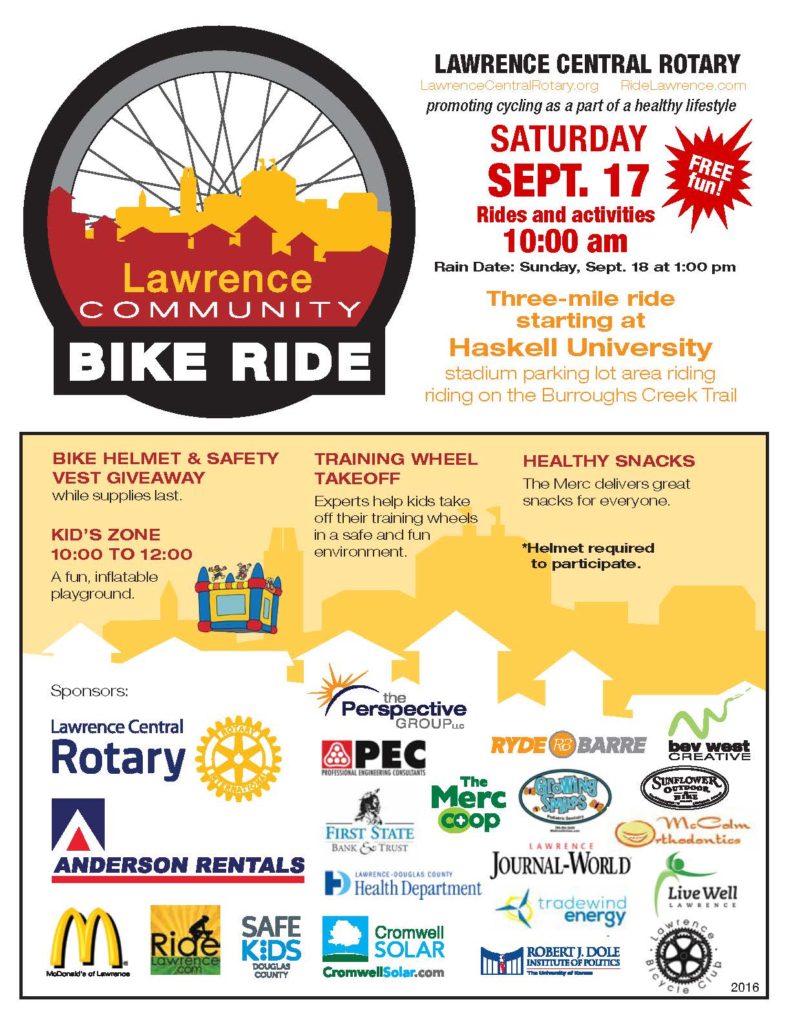
    The 2016 Lawrence Community Bike Ride on Saturday, September 17th, at the Haskell University stadium parking area and using the Burroughs Creek, and recently refinished bike Trail south of Haskell.

    The event is open to anyone and there is no cost to participate.

    There will be a three-mile ride along the Burroughs Creek Trail.

    Other activities from 10 a.m. to 12 p.m. include:

    • A Training Wheel Takeoff. Experts will help children who are ready to take off their training wheels in a safe environment.
    • Bike Rodeo. Kids can practice and improve their riding skills
    • Bike Helmet Fitting and Giveaway. Safe Kids with LMH will help outfit kids with helmets, while supplies last, along with providing cycling safety tips for kids of all ages – and for adults too!
    • Inflatable Bounce House and Slides for the kids!

    “One of our goals as a club is to get more and more people discover cycling and an active lifestyle as a fun and healthy activity,” said Steve Lane, a member of Central Rotary Club. “This event is a great opportunity for families and individuals to enjoy cycling in a safe and scenic area on Lawrence’s east side.”

    If it is raining September 17th, the ride will be rescheduled for on Sunday, September 18th, at 1PM.

    Registration for the event is required and can be done before the event.

    Releases will be available at the event or you can download one HERE to fill out ahead of time.

    Thanks to all our sponsors and partners who help to make these events happen in Lawrence.

    Lawrence Fall Community Bike Ride 2016

  • Kansas River Keeper Dawn Buehler on Protecting and Preserving the Kansas (Kaw) River

    ks-river-keepersThe Kansas River Keeper sounds like a mythical being but is actually a native Kansan who says she is the eyes, the ears and the voice of the river.

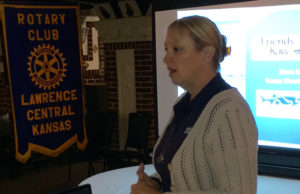
    Dawn Buehler is the Kansas River Keeper and says her mission is to protect and preserve the Kansas (Kaw) River for future generations.

    Buehler heads an organization of more than 100 volunteers who work to maintain the river quality on the longest prairie-based river system in the world. The Kansas River watershed covers 53,000 square miles and  is part of the Missouri River watershed that includes parts of Colorado and Nebraska as well as Kansas.

    From her office in DeSoto, she responds to pollution reports from the Kansas Department of Health and Environment and uses the USGS site to check for safe water levels. Challenges to the river include storm water, land use changes, agriculture, population increases which increase demands on the river, and the need to protect the drinking water supply.The River Keeper volunteers work with groups and companies such as Westar Energy, Bowersock, and the Kansas Basin Regional Advisory Committee as well as listening to public input. They are supported entirely by grants, fund raising events and donations.

    The River Keeper volunteers work with groups and companies such as Westar Energy, Bowersock, and the Kansas Basin Regional Advisory Committee as well as listening to public input. They are supported entirely by grants, fundraising events, and donations.

    The Kansas  River is one of three public waterways in the state and the volunteers encourage paddle trips and educational activities on the river.friends-of-the-kaw

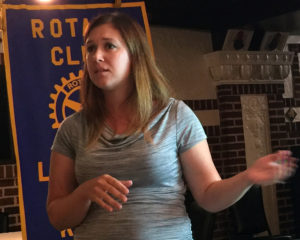
    River Keeper events this fall include a September Lawrence to Eudora paddle and an October cleanup where the Kaw meets the Missouri.

    For more information visit the Friends of the Kaw Website.

  • KU’s James Modig Discusses the New Central District Project to Lawrence Central

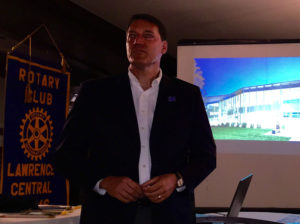
    james-modigProgress on the Central District Development Project is increasingly visible at Kansas University. The $350 million project is transforming a 45-acre space that lies north and east of the Iowa and 19th Street into “Innovation Way.”  Financing was completed and construction began in January 2016.

    Jim Modig, University Architect and Director of Design and Construction Management (DCM) at KU, took care to describe the scope and history of the project in his presentation to the club.  The project is the tangible result of KU’s Master Plan for 2014-2024.  In particular, that plan recognized that existing spaces for science classes at KU were suffering from delayed maintenance and were too small, unsafe, and outdated to attract the best students.

    The scope of the Central District Development work includes creating Jayhawk Trail that will tie the campus together end-to-end with accessible access for pedestrians and bicyclists.  A new Integrated Sciences building is designed to encourage innovation and collaboration among students of various scientific disciplines.  A new student union with flexible conference space, a parking garage for 600 cars, a new central utility plant, new apartments, and a new residence hall with dining facility are also part of the plan.  The images of the residence hall in time lapse photographs reveal the speed of the work.

    Companies from all over the world expressed interest in bidding on this project, Modig said, but after reviewing the qualifications of those companies, the project team asked for a Request for Proposal (RFP) from three firms.  The RFPs addressed building of the science facilities, modernizing the campus infrastructure, providing student housing, and addressing ongoing operations and maintenance.

    The Central District Development Project has been financed through a public/private partnership (P3), a non-profit entity that ensures that the State and the Board of Regents are not liable for the debt.

    The economic impact of the Central District Development Project is significant, according to Modig.  The project employs more than 8,500 people directly and indirectly.  For every $1 spent, the project generates $2.47 in incremental economic value.  Seventy-five percent of the subcontractors for the projects underway have been awarded to Kansas-based businesses;  another 20% have gone to companies in the Kansas City area; only 5% have been given out-of-state.

  • Beth Llewellyn Discusses Health Care for the Uninsured

    Beth-LlewellynBeth Llewellyn, executive director of Health Care Access, spoke to Lawrence Central Rotarians about the mission and the services of this “safety net” clinic for low-income and uninsured individuals living or working in Douglas County.  Llewellyn grew up in Lawrence and returned to take charge of Health Care Access in June of 2015.  Llewellyn has 25 years of experience in health care administration and has a strong personal conviction that good health care should available to everyone.  The clinic operates on a sliding fee scale with 26 percent of the people served being unable to pay anything.  Unfortunately, this number is increasing.

    Clinic services include primary care, chronic disease management, counseling and psychotherapy, referral coordination, prescription assistance, resource navigation management, case management, wellness management, and on-site physical therapy.  Some 59 percent of the people served are at or below the Federal Poverty Line.  Many of them suffer from hypertension, diabetes, or mood/behavior disorders.

    Beth Llewellyn Health Care Access | Lawrence Central RotaryHealth Care Access, located at 330 Maine Street, has a staff of fifteen and an operating budget of $950,000 and is governed by a private board of directors.  The organization works with a number of health care related partners that make up a network of health care assistance and expertise.  In addition to fees and donations, financial support comes from the State of Kansas Department of Health and Environment, the City of Lawrence, Douglas County, and the United Way.

    What is the biggest challenge or need?  Beth Llewellyn urged support of the expansion of Medicaid in Kansas.  More information is available on Health Care Access at healthcareaccess.org.

  • eXplore Lawrence’s Michael Davidson Talks Tourism to Lawrence Central Rotary

    Michael Davidson | eXplore Lawrence | Lawrence Central RotaryLawrence is known as a place that is quirky, cool, fun, eclectic, and out-spoken.  “Like a great film, it leaves you wanting more.”

    The challenge to eXplore Lawrence, the non-profit entity now responsible for promoting and managing Lawrence tourism, is to understand the Lawrence brand and capitalize on it, according to Michael Davidson, Executive Director since April 1, 2016.  The entity, funded by the city’s transient guest tax, anticipates a 2017 budget of $990,000.  With the slogan “Unmistakably Lawrence,” the City is well on its way to enhance its reputation as a destination.

    eXplore Lawrence is focused on encouraging visits not only for leisure activities, but also for conventions, meetings, and training events held by corporations.  Currently, according to Davidson, 25,000 people in Lawrence work in tourism-related businesses—attractions, hotels, restaurants, and support services—generating an estimated $5 million in the local economy.  For every $1 spent in tourism, $8 dollars gets churned into the economy.  And Davidson also points out the fact that the industry provides numerous entry-level jobs for workers in the area.

    Recently, eXplore Lawrence invested in a professional survey to identify ways to become even stronger and more effective in its efforts.  In addition, the group is using social media in innovative ways, collecting pictures and videos from folks who have actually visited Lawrence and re-posting them on their website.  They also use technology that alerts them when people who have explored the website actually come to visit the community.