Excaliber, a choir of seventh and eighth graders from Central Memorial Middle School, performed for Rotarians and their guests at the annual holiday luncheon.
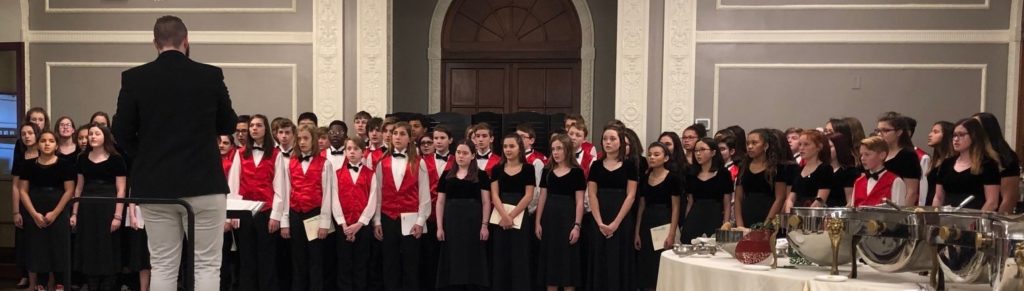
Excaliber, a choir of seventh and eighth graders from Central Memorial Middle School, performed for Rotarians and their guests at the annual holiday luncheon.
 Jim Peters, Director of Osher Lifelong Learning Institute and fellow member of Lawrence Central Rotary, tells the story of the underground railroad in Lawrence.
The Lane Trail, named for abolitionist James H. Lane, was established in 1856 to bypass proslavery strongholds in Missouri and provide free-state settlers a safe route into Kansas with terminus in Topeka. The trail is approximated today by US Highway 75. Settlers left Iowa City to go west into Nebraska and south into Kansas, but John Brown and others used the trail in reverse to transport slaves north to freedom.
Frequently, runaway slaves would hide in and around Lawrence as they waited to join a group traveling north to safety. Gover Barn in Lawrence was a key staging area during the 1850s. In December 1858, the barn housed slaves recruited in Missouri by John Brown as they awaited their chance to escape.
Narratives written by Lawrence and Douglas County residents tell of the perils of hiding slaves during this era. Many describe the relationships they built with the runaways and their concern for them after they left their protective barns and cellars.
 Dr. Robert Smith, Director of the Fort Riley Museums, declared that it has been adaptation that has kept Fort Riley open over the decades, evolving repeatedly to meet the army’s needs.
Established as a frontier post in 1853, at the time Fort Riley was situated at the “end of civilization.” As the boundary of the frontier changed, however, the fort had to adapt its role to remain open. By the late 1800s, it became a “school post” for the cavalry and light artillery and served as a haying station for the entire army.
When World War I began, Fort Riley was the largest U.S. training site for troops headed to Europe, and it continued to be a training site during World War II. During that era, it became the Divisional Post for the First Infantry.
The First Infantry Division, known as “The Big Red One,” is the oldest continuously serving division in United States history, sending troops to France in World War I and to North Africa, to Sicily, and to England in World War II. First Infantry troops participated in D-Day at Omaha Beach, were stationed in Germany during the Cold War, and went to Vietnam. They were present for Operation Desert Storm in 1991, Operation Iraqi Freedom, and Operation Enduring Freedom in Afghanistan.
 Russ Johnson, the CEO of LMH, talked about the new LMH Health West Campus development that broke ground in September 2018. Joining him were Rebecca Smith, Executive Director of the LMH Health Foundation, and Karen Shumate, Chief Operating Officer and project manager for the new facility.
The West Campus expansion has been designed to provide outpatient services, the primary source of revenue that is anticipated in the health care industry in coming decades. The location of the new facility on Highways 10 and I-70 will be convenient for healthcare consumers. Plans for easy and adequate parking have been highly important in the plans, as the current hospital location lacks adequate parking. LMH West Campus will be 35-40% of the space at the current hospital. Johnson expects the new building to be ready for occupancy in July 2020.
Shumate highlighted key features in the floor plan of LMH West Campus. The goal is to build something “nice, but not ostentatious.” The building incorporates flexible space and room for expansion. There will be an outdoor ampitheater and a roof garden. LMH physical therapy services, OrthoKansas, a pharmacy, a lab, and several local physician practices will relocate. The second floor will be a Women’s Center, providing a continuum of care for breast patients at one location.
 Leticia Cole stands with sponsor Steve Lane during her induction into Lawrence Central Rotary.
Leticia has worked for Paul Werner Architects for over 11 years. She is a 2014 graduate of Leadership Lawrence and has been a board member of Catch-A-Break for the past two years.