Author: Kate Campbell

  • United We Win!

    Jannette Taylor has been President and CEO of United Way of Douglas County for only nine months, but she is clearly the right person to provide strong leadership for the organization.

    Prior to coming to Lawrence, Taylor earned a reputation for championing social justice concerns in Omaho, NE.  Among other initiatives, Taylor founded and led a community-based nonprofit, Impact One Community Connection. This small nonprofit worked to provide life-changing services to at-risk youth and young adults.

    Now Taylor champions the three areas of focus that the United Way of Douglas County has identified for its efforts in Douglas County:

    academic success of all children;
    health access for all; and
    financial stability of every person.

    The 2017 Annual Report tells stories about households dealing with these issues.  It also outlines the scope of these challenges and highlights the ways that United Way has mobilized community resources and developed partnerships to meet them.

    Taylor explains that the agency uses the “community impact model” to target resources and avoid duplication of effort.  The model also employs an assessment tool to gather data about needs and results.


  • Lawrence Kids Calendar Goes to the Movies

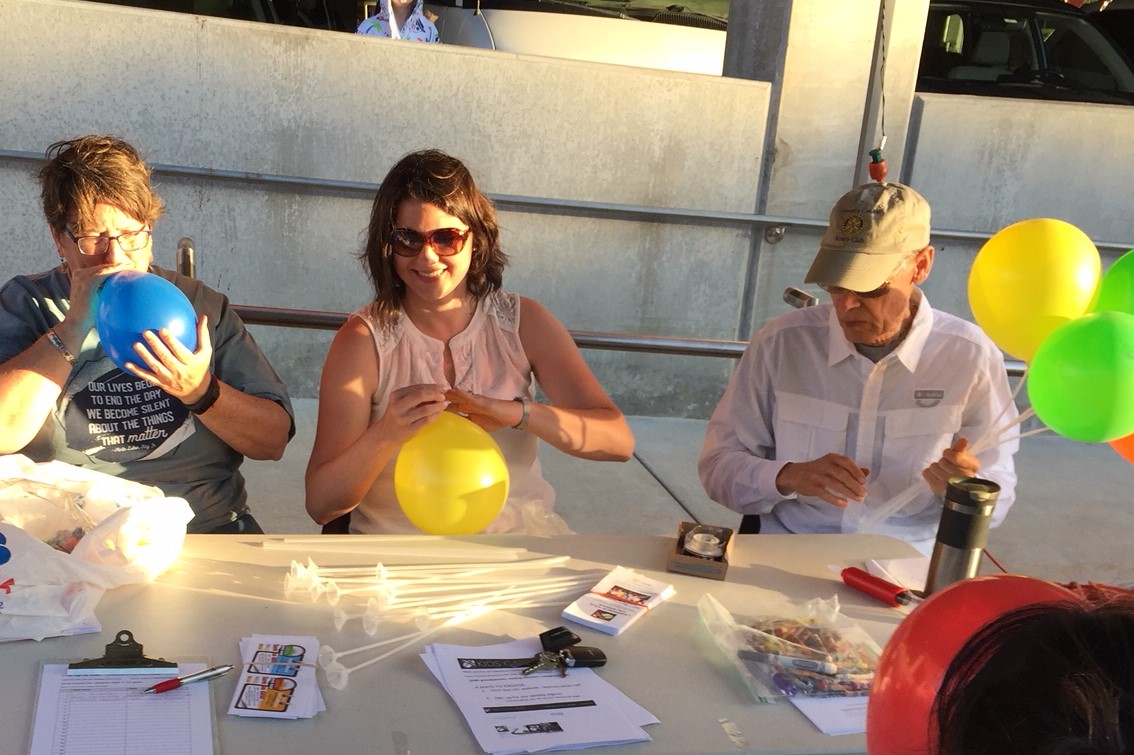
    Lawrence Central Rotarians distributed balloons on a stick  to promote Lawrence Kids Calendar at  “Dinner and a Movie” night on the library lawn.  Pictured as they smile and greet, blow and tie are Lynn O’Neal, Lee Anne Thompson, Margaret Brumberg, and Vern Brobst.

  • RI President Ian Riseley Greets District 5710

    When Rotary International President Ian Riseley came to District 5710 on Wednesday, May 30, Lawrence Central Rotarians attended the reception.  Janis Bunker, Lee Anne Thompson, and Kate Campbell made the drive to Atchison, KS, for the event.

    A performance by the Top Dogs Drill Team launched the gathering with rhythm and enthusiasm.

    In addition to making comments from the podium, Riseley helped to honor recent Paul Harris Fellows from the District and unveiled a marker indicating that three new trees outside the Atchison YMCA were placed in response to Eiseley’s challenge to plant a tree for every Rotarian during his year in office.

  • Adrian Zink Tells Stories Overlooked in Kansas History

    Adrian Zink, a Kansas native, had his interest in history sparked by a high school teacher who made the past come alive with interactive classroom experiences.  After  earning a degree from KU, he worked at museums, universities, archives and historic sites.  His recently published book, Hidden History of Kansas, digs deep into the state’s history to relate the overlooked stories of “fascinating firsts, humorous coincidences, and intriguing characters.”

    One of Zink’s favorite stories is about auto polo.  A sport dreamed up in 1911 as a marketing stunt by a Ford dealer in Topeka,  it became popular coast to coast  into the 1920’s.  The matches pitted two cars per team against each other with two men in each car–one to drive and one to hit the ball with the mallet.  Truly a “lunatic game,” it did lead to the first patented roll bar for a vehicle.

    Boston Corbett is the man who shot John Wilkes Booth, Abraham Lincoln’s assassin, despite orders to capture Booth alive.  Courtmartialed over the incident, the trigger-happy Corbett became notorious for his erratic behavior, likely caused by mercury poisoning from the years he was a hat-maker.  He moved west and homesteaded in Kansas, became a street-corner preacher, and eventually was hired as a doorkeeper for the Kansas House of Representatives.  When he brandished a gun inside the statehouse, the legislators committed him to the state mental asylum.  Two years late, he escaped and was never found again.

    Railroad executives renamed the town of Weeks, KS,  after a St. Louis baseball player named Bushong in 1886 without consulting the residents.  Why? Because the St. Louis Browns had won with World Series over the Chicago White Stockings that year.

    Susanna Salter became the first female mayor in the United States in 1887.  Nominated as a joke by the men in Argonia, KS, she was elected by a strong majority just weeks after women had been given the right to vote in Kansas city elections.  She served capably but briefly, leaving office after one year and never seeking elected office again.

  • Health and Quality of Life Requires Community-Wide Focus

    Dan Partridge, head of the Lawrence-Douglas County Public Health Department, shared a report on the health of Lawrence .

    The forty-two people who work in the Public Health Department are proud of its designation as an “accredited health department.”  Together, they strive to fulfill their mission:  To improve health for all.

    According to Partridge, quality of life for a person and for a community are impacted by the same factors.  About 10% is influenced by health care; 10% by the physical environment; 40% by socio-economic factors; and 40% by health behaviors.

    Douglas County is among the top ten counties in the country on many measures.  The community compares particularly well regarding its low teen birth rates and its few preventable hospital stays, for example.  Areas that need more work are in affordable housing, excessive drinking, social isolation, and income inequality.  All such issues are complex and difficult to impact.  On many measures, a distinction is apparent between the quality of life in East and North Lawrence as compared to West Lawrence.

    Public health has 140 years of history in Kansas, Partridge says.  At the onset in 1885, the focus was on improving the environment.  By the 1940’s, 50’s, and 60’s, the emphasis was on disseminating the innovations made possible by medical science.  Vaccination services, family clinics, and the Healthy Family Program all emerged in that era and continue today.  In the future, community health must re-invent itself once again to address new dangers, moving beyond the clinic and into the community itself.  Currently, the Department is focusing on healthy foods and physical activity, poverty and jobs, behavioral health, and affordable housing all viewed through the lens of discrimination and racism that unfortunately underlies each of these issues.